
Hialeah illuminated signs
LED Channel Letter Signs in Hialeah
Walk a block of Palm Avenue or West 49th Street on a Saturday and you will see what Hialeah actually is: panaderia counters lined up before 7 a.m., quinceanera shops next to auto parts stores, botanicas beside check-cashing storefronts, and a lit sign over almost every one of them working overtime to be read from a car going 35 miles an hour. Hialeah is one of the most densely packed cities in Florida and one of the most overwhelmingly Spanish-speaking cities in the country, and that combination changes what a good storefront sign has to do here. It has to be legible fast, in whatever language the block reads in, and it has to survive a South Florida summer without a service call. LED channel letters are the sign that does all three, and Titans of Print builds them from a nearby Doral shop, with site visits and installation dates arranged for the project.
Choose a glowing front-lit face, a halo behind the letters, or both. Titans designs, fabricates and installs illuminated lettering from its Miami/Doral base. Browse real signs below, compare the construction and face options, then send your logo and property details for a quote.

Get a Quote for Your Hialeah Sign
Send your logo, approximate sign size, property address and target date. Include a photo of the full storefront or building front and any written property sign criteria so we can quote the lettering and mounting together.
Channel Letter Sign Gallery
See real channel-letter signs, including storefronts, building names, logos and raceway installations. If you like an example, tell us whether it is the lighting, color, letter style or mounting that you want for your sign.


Facade planning for businesses in Hialeah
Hialeah storefronts along West 49th Street, Palm Avenue, and Okeechobee Road serve different traffic and parking approaches. A plaza tenant may share a sign band; a freestanding frontage may have more wall area. Photograph the driveway, directory, and exact tenant bay so the proof reflects how customers find the business.
Ask management to distinguish the tenant's sign from the center's shared identity or directory. Request the current sign package and confirm available dimensions, colors, illumination, and mounting. If a shared panel is full, ask whether alternate tenant locations are allowed before designing around a space that may not be available.
Use the property photos to compare how the sign reads from the driveway and at the storefront. Front-lit letters brighten the face, halo-lit letters cast light onto the wall, and dual-lit combines the two when the logo supports it. Nearby signs, a canopy, and reflective surfaces may affect contrast, so review the proof in context.
For a Hialeah quote, send the address and suite, approved logo, sign measurements, driveway and tenant-bay photos, target date, and written property rules. Include the property directory and management contact, plus any access instructions. Identify whether you want survey, permit coordination, electrical scope, shipping, or installation included.
Coordinate this sign with Hialeah exterior building signs, Hialeah illuminated signs and Hialeah office lobby signs. Share separate dimensions and photos for each location.
Front-Lit, Halo-Lit or Both?
These three lighting styles use different face and back materials. The diagram shows the construction and the effect each one creates. Choose the look you want, then check it against your wall color, available space and landlord’s sign requirements.
Front-lit channel letters
LEDs inside the letter shine through a translucent acrylic face. The face is the bright part you see at night, while the metal sides give the letter its depth. This is a familiar choice for shops, restaurants and showrooms where a name needs to stand out from the road or parking lot.
White acrylic, colored acrylic and translucent vinyl treatments give you different ways to carry your brand colors. Some front-lit letters have a trim cap around the face; the finish and face treatment are part of the approved design.
Reverse-lit or halo-lit letters
These have an opaque face and LEDs that shine toward the wall. Spacing behind the letters lets the light form a halo around the outline. Painted or metal faces remain visible during the day, with a softer glow after dark.
The wall is part of the effect. A smooth, light wall reflects the glow differently from dark brick or textured cladding. The stand-off distance and letter spacing need to work with that surface.
Front and back lit letters
A translucent face and a clear back let the sign light forward and create a halo behind it. You can also combine different lighting treatments within a logo, such as a glowing name with a backlit symbol.
This gives you more control over the nighttime look, but adds lighting and wiring decisions. We show which parts illuminate on the drawing so you can approve the effect before fabrication.
Illuminated office logos
Indoors, a lit logo is usually seen much closer. Letter depth, brightness and the cable route matter beside a reception desk or decorative wall. The same brand can use a smaller interior sign without copying the exterior installation.
For other indoor treatments, compare office lobby signs, edge-lit acrylic signs and custom acrylic signs. LED neon creates a different line of light and is a separate product.

For more lighting examples, see backlit channel letters or our guide to front-lit versus halo-lit signs.
What Color Will the Face Be, Day and Night?
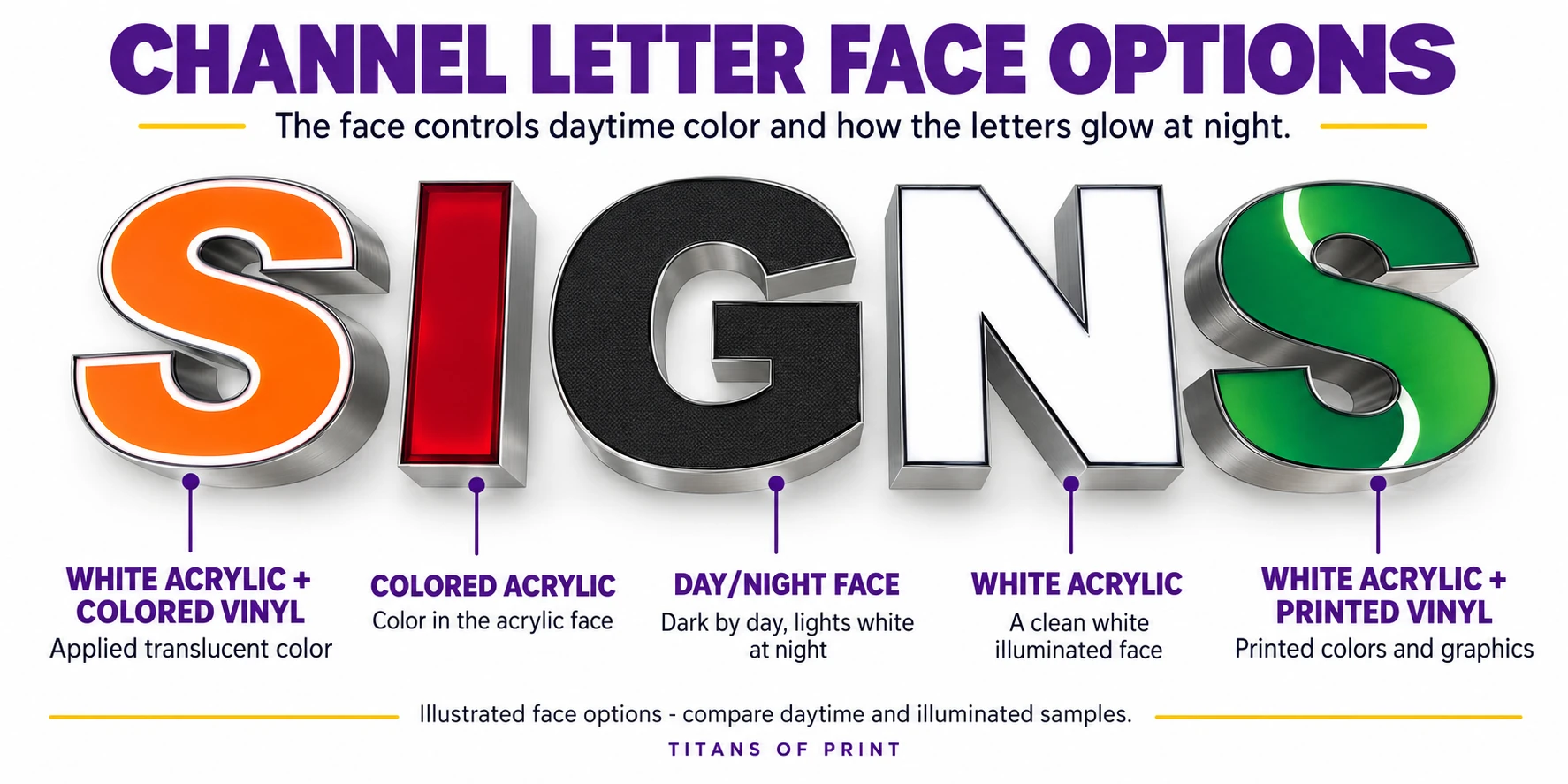
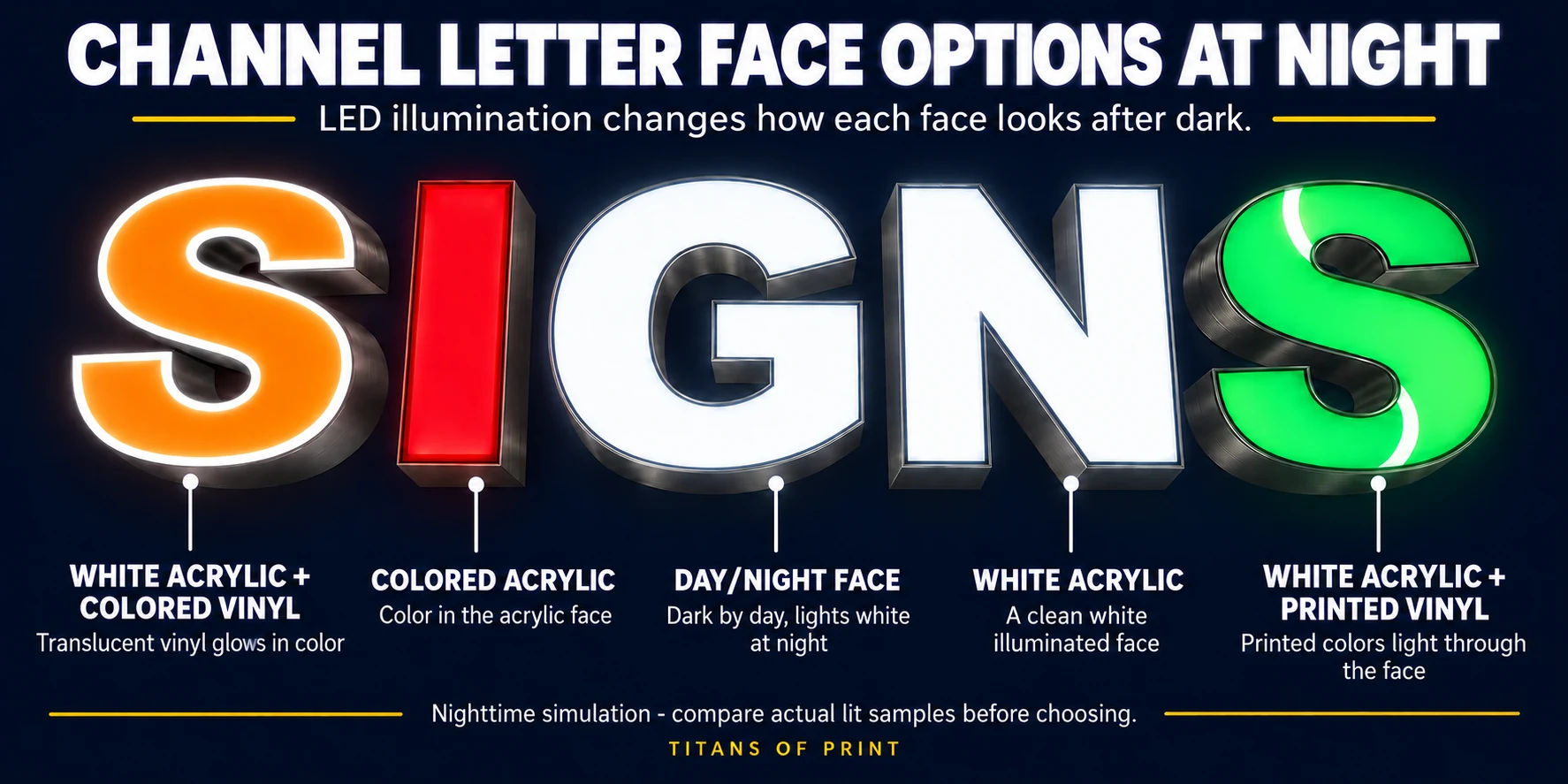
The face is the front surface of a channel letter. It controls the daytime color and how light passes through the sign after dark. The illustrated options below show why the face material deserves its own decision, even when the letter shape stays the same.
Daytime: lights off
Nighttime: LEDs on
White acrylic with colored vinyl
A white translucent acrylic face can carry applied colored vinyl. This gives you a colored face while letting light through it. The original material example shows 3M colored vinyl; the selected film and acrylic should suit an illuminated sign.
Colored acrylic
The color is in the acrylic itself. It can be a good fit when an available acrylic color suits the logo. Check the color both unlit and illuminated, because the glow may look different from a printed brand reference.
Plain white acrylic
A white face gives a clean, bright illuminated letter. It is useful for simple wordmarks and for signs where white lettering provides strong contrast against the building.
Black and white day/night faces
A day/night face is designed to look dark during the day and light up white at night. It gives you an alternative when a black daytime wordmark would otherwise lose its readable face after dark. Ask to see the lit effect alongside the daytime finish.
Printed vinyl on white acrylic
Printed translucent vinyl allows graphics or multiple colors on the face. The original example includes 3M printed vinyl. The print, film and acrylic work together, so we review the illuminated color as well as the daytime artwork.
Bring your brand colors or Pantone references. We help select the closest suitable face and return finishes, with samples or proofs to approve how the sign will look in both conditions.
How Your Channel Letters Are Built
Each letter is a separate three-dimensional body. Aluminum backs and sides, called returns, form the structure. A typical front-lit letter has an acrylic face, LED modules inside and wiring connected to a power supply. With direct mounting, the wall shows through between the letters.
Common construction uses aluminum returns around .040 to .063 inch thick and letter bodies about 3 to 5 inches deep. Depth, face material and the back arrangement can change for a halo-lit or specialty sign. We confirm those details on the drawing for your job.
The LEDs sit inside the letter body, while the face and return finishes carry the brand’s appearance. A clear back can let light reach the wall for a halo effect. Outdoor construction also needs appropriate wiring pass-throughs, sealing and drainage, as shown in the lighting diagram.
From artwork to finished sign
- Approve the design: confirm the wording, logo, size, lighting, colors and mounting position.
- Make the letter bodies: cut the backs and form the returns to the approved shapes.
- Prepare the faces: cut the acrylic or metal and apply the selected face treatment.
- Fit and check the lighting: position the LED modules, route the wiring and test the illuminated effect.
- Prepare for installation: match the letters, mounting hardware and layout template to the agreed installation.
Keep the final drawing and component information with your building records. They make future service and replacement work easier to match to the original sign.
Choose Letter Size for the Distance People Will See It
A sign read from a sidewalk needs a different scale from one seen across a parking lot or from a busy road. Start with the distance between your sign and the people you want to reach. Then check the available sign area and the size the property allows.
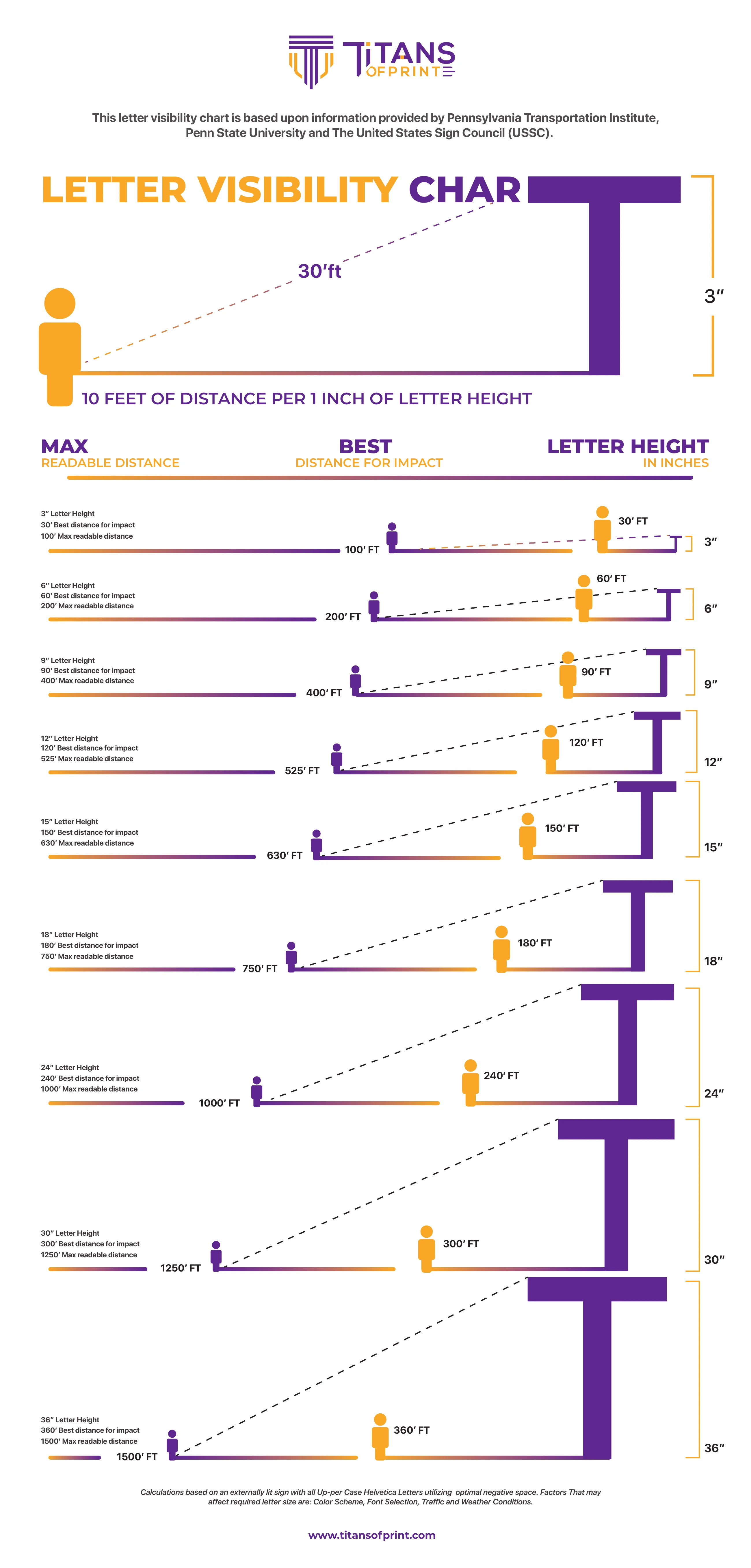
Our chart uses about 10 feet of viewing distance for each inch of letter height as a starting point for impact. That puts a 12-inch letter at about 120 feet and a 24-inch letter at about 240 feet. Those are planning examples, not guarantees: thin strokes, decorative lettering, poor contrast and an angled view can make the same letters harder to read.
Send a wide photo from the actual approach. We can review letter height, spacing and logo proportions together. Read more in our channel-letter size guide.
| Letter height | Distance for impact | Maximum readable distance |
|---|---|---|
| 3 inches | About 30 feet | 100 feet |
| 6 inches | About 60 feet | 200 feet |
| 9 inches | About 90 feet | 400 feet |
| 12 inches | About 120 feet | 525 feet |
| 15 inches | About 150 feet | 630 feet |
| 18 inches | About 180 feet | 750 feet |
| 24 inches | About 240 feet | 1,000 feet |
| 30 inches | About 300 feet | 1,250 feet |
| 36 inches | About 360 feet | 1,500 feet |
The chart’s longer maximum distances assume favorable conditions and simple uppercase lettering. For a moving driver, quick recognition matters more than being able to work out the name from the farthest possible point. The International Sign Association’s placement guidance also explains how traffic, letter style and viewing conditions change the size needed.
Direct Mounting, a Raceway or Stand-Offs?
Letters mounted directly to the wall
Individual letters attach to the building, with the wiring route planned behind them. This lets the wall remain visible between the letters and keeps a separate mounting enclosure out of the finished view. The wall material and access behind it affect the installation.
Letters mounted on a raceway
A raceway is an enclosure behind the letters that carries wiring and can house the power supply. It lets the sign mount as an assembly through a planned set of fixing points. Some landlords prefer or require it, especially where they want a consistent sign system for tenants.
The raceway can be finished to suit the wall, but it remains a visible part of the sign. Check the landlord’s criteria before choosing direct mounting or a raceway; one method is not required at every property.
Stand-offs for halo lighting
Reverse-lit letters need a gap behind them so the LEDs can shine onto the wall. Studs and stand-offs set that spacing while securing the letters. The right distance depends on the desired glow, the wall and the approved mounting details.
What the raceway diagram shows
The main building-power connection feeds the power supply. Secondary wires run to the LEDs through planned pass-throughs. Mounting holes and the hanger bar support the assembly, while drainage holes help water leave the enclosure.
The pictured 6-inch by 5-inch enclosure and 2-inch hanger bar are example dimensions. Your installation drawing specifies the raceway size, fixing method and electrical arrangement for your sign.

For a replacement sign, include photos of the old fixing and wiring points and tell us whether removal or wall restoration is needed. Our channel-letter installation guide explains the details to gather.
Why Some LED Signs Are Hard to Install
A clean-looking sign still needs a practical wiring route. Separate letters may need several connection paths; a solid wall, a finished ceiling or another occupied room behind the sign can limit where those wires go. A suitable backer or raceway can help organize the connections, but its power feed and future service access still need a plan.
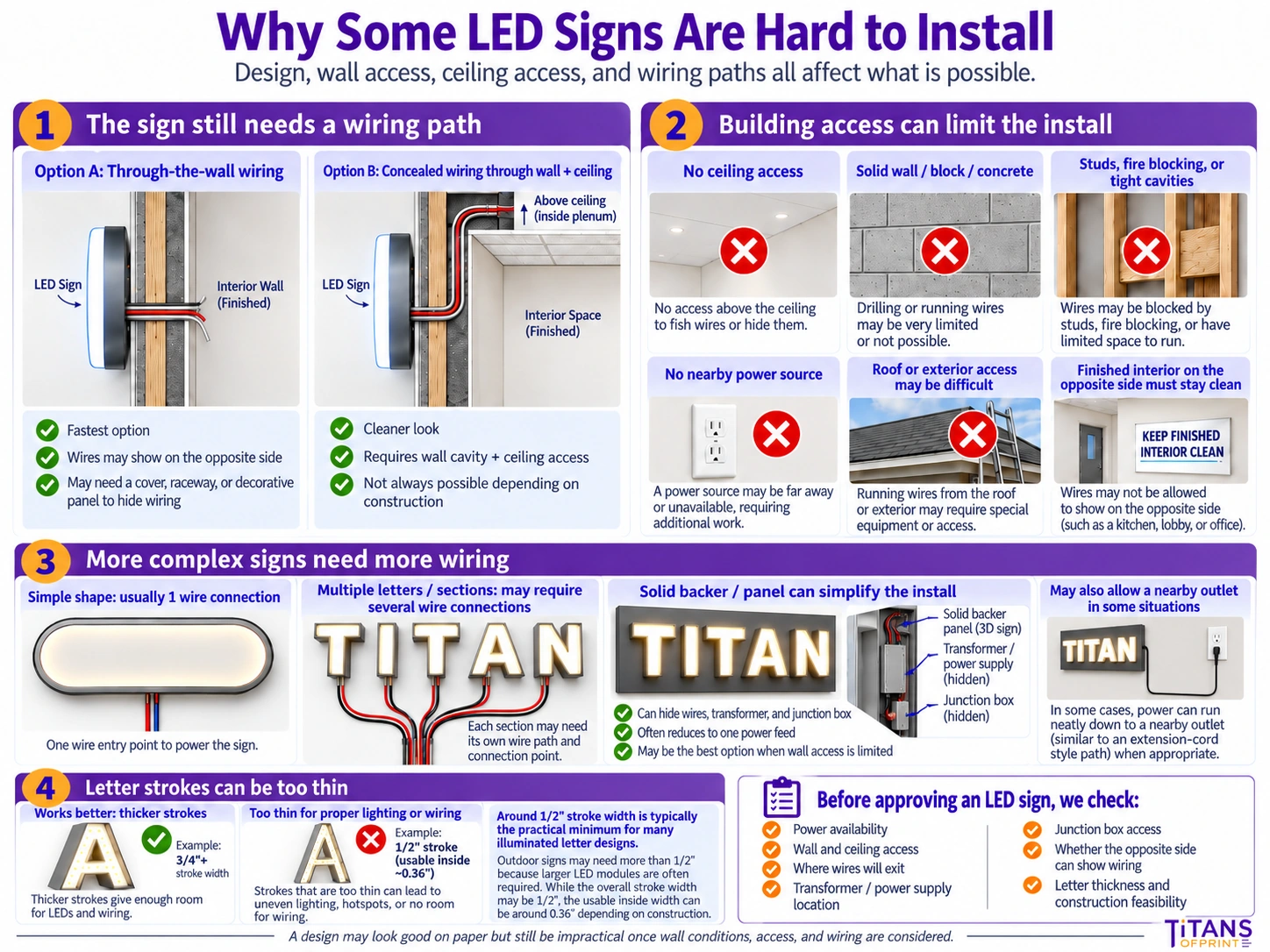
Thin logo strokes also leave less space for LEDs and wiring. The dimensions in the graphic illustrate one construction; the actual module, letter depth and usable cavity determine what fits. Send photos of both sides of the wall, any ceiling access and the known power location with your artwork.
Read the full guide to LED sign wiring, wall access and installation requirements for the options to review before fabrication.
What Makes an LED Channel Letter Sign Different From a Panel Sign
A channel letter is not a rectangle with your name printed on it. Each letter of your logo is its own fabricated unit : an aluminum return bent to shape, usually .040 to .063 gauge and 3 to 5 inches deep, capped with an acrylic face in your brand color and framed by a trim cap that seals the seam. Inside, low-voltage LED modules wire to a UL-listed power supply. There is no exposed tubing and nothing to gas-charge; it is a sealed, serviceable, all-electric assembly. Because the letters mount individually rather than on one backer panel, the wall shows through between them and the sign reads as part of the building rather than a box stuck on top of it. That is why channel letter signs are the default over most of Hialeah’s commercial corridors, from the small retail bays on East 4th Avenue to the bigger anchor storefronts along Okeechobee Road.
Front-Lit and Halo-Lit, and Why the Choice Matters More Here
Front-lit letters have a translucent face that glows evenly, which is the loud, high-visibility option most retail, food, and service businesses in Hialeah want : it competes well against the string of other lit signs on the same block. Halo-lit (reverse-lit) letters use a solid face and throw their light backward onto the wall, giving a quieter, upscale silhouette that medical offices, professional services, and newer corporate tenants near the Palmetto Expressway tend to prefer. Some businesses run both effects on the same letter set for maximum presence. If you are deciding between them, our page on front-lit versus halo-lit channel letters breaks down where each wins, and we build the halo option as its own product on our backlit channel letter signs page.
Bilingual Signage Is Not an Afterthought in Hialeah
Most Hialeah signs are read in Spanish first, English second, or both at once, and a two-line or dual-language layout changes the letter math. Two lines of copy mean shorter letter heights than a single-line English name would get in the same footprint, so the size, spacing, and stacking have to be planned before fabrication, not adjusted after the fact. We lay out dual-language and abbreviated Spanish signage the same way we would any other logo : matched to your actual brand copy, sized to the code-allowed letter height for your storefront, and proofed with you before a single letter gets cut. Getting this right up front avoids the common mistake of cramming a second line onto a sign that was only ever designed for one.
Permitting Through the City of Hialeah and Miami-Dade County
Outdoor structural design and permit requirements must be checked for the sign and actual address. Because Hialeah sits inside Miami-Dade’s High-Velocity Hurricane Zone, that permit package has to include signed and sealed wind-load engineering for the sign and its attachment to the wall : the county will not sign off on a set of letters bolted up without calculations behind them. This is where a lot of cheap out-of-area quotes quietly fall apart, because the vendor has never built an HVHZ submittal. We handle design, structural engineering, the permit application, and the final inspection in-house, so nothing stalls waiting on a third party to produce paperwork.
Mounting on Strip Retail, Warehouse Facades, and Older Storefronts
Hialeah’s building stock is a mix: older masonry storefronts downtown, mid-century strip retail along Palm Avenue and Hialeah Drive, and tilt-wall warehouse and flex-industrial buildings toward the Okeechobee corridor and the rail lines. Each takes the letters differently. Flush mounting works cleanest on solid masonry with rear wall access. Multi-tenant strip centers, where the landlord does not want individual penetrations scattered across a shared facade, usually call for a raceway : a slim aluminum enclosure that carries the wiring and power supplies and mounts through one controlled set of holes. Tilt-wall warehouse and showroom fronts, common on businesses fronting the industrial parks near the Palmetto Expressway, often take a raceway too, since there is rarely open interior access behind a concrete panel. We assess your building type before we quote a mount, not after.
Built to Survive Heat, Storms, and Salt-Laden Air
Hialeah’s HVHZ engineering requirement is not paperwork for its own sake. Summer heat cycles the aluminum and acrylic every single day, afternoon storms test every seal and fastener, and the same humid air that reaches the coast reaches inland Miami-Dade too, slowly working on unprotected metal. We build with UV-stable acrylic faces that hold their color instead of yellowing, and powder-coated aluminum returns and trim caps that resist corrosion. Combined with sealed, low-voltage LED modules, that is what keeps a Hialeah sign looking new after five summers instead of needing a repaint or a re-face.
Day Visibility, Night Visibility, and How Long the LEDs Last
A sign earns its keep in two very different conditions. In daylight, the acrylic face and painted return carry your brand color as a solid, legible graphic against Florida sun glare. After dark : which is when a large share of Hialeah’s restaurant, retail, and personal-service traffic actually happens : the LEDs take over and the sign becomes the thing a driver actually notices. We match faces to your exact Pantone reference so the sign reads as your real brand color, not a close guess, and we size letters to the distance they need to be read from: a sign meant to be seen from Palmetto Expressway traffic needs a different scale than one meant to be read by a pedestrian on a narrow retail sidewalk, which is why we help you land on the right letter size before anything is fabricated.LED service life depends on the specified components, operating conditions and maintenance.
Matching the Sign to Hialeah’s Business Mix
Hialeah’s economy is built on small, family-owned operations more than corporate chains, and the right sign reflects that variety. Panaderias, restaurants, and grocers along Palm Avenue and West 49th Street generally want bright front-lit letters with strong color that reads fast from a moving car. Auto repair shops, tire dealers, and parts distributors near the industrial corridors want large, simple, high-contrast lettering built for durability over polish. The professional offices, clinics, and newer corporate tenants near the Palmetto Expressway lean toward halo-lit letters in metal finishes for a calmer, more established look. And plenty of these same businesses want a matching lit or non-illuminated identity at the reception desk inside : something our office lobby signs and metal logo signs cover well, alongside edge-lit LED signs for a slimmer interior accent piece. For businesses that want the broader illuminated-signage picture beyond channel letters specifically, our illuminated business signs page rounds out the options, and our work on exterior building signage covers what goes above and around the letters themselves.
Value-Conscious Does Not Mean Cheaply Built
Hialeah is a city of tight margins and family budgets, and most owners here are not shopping for the flashiest sign on the block : they are shopping for the one that keeps working without a callback. That is a reasonable instinct, and it should shape how a sign is specified, not whether it gets built well. A properly gauged aluminum return, a correctly sized power supply, and LED modules spaced to the manufacturer’s spec cost a little more up front than a corner-cut version of the same sign, but they are also the difference between a sign that still looks sharp in year six and one that is showing dark spots or a peeling face by year two. We will tell you honestly where you can save : a smaller letter set, a simpler mount, front-lit instead of a heavier halo-lit build : and where cutting corners just means paying for the same sign twice. If you are unsure whether your storefront even needs a permit for what you have in mind, our explainer on whether a business sign needs a permit is a fast way to get oriented before you call.
Property Approval, Permits and Installation
Confirm the current landlord or property sign criteria before approving the design. They may cover the location, overall size, colors, lighting or mounting method. The applicable permit and engineering requirements depend on the actual address and project.
Titans handles or significantly assists with permitting where required and coordinates survey and engineering needs. Send the written property criteria and the site address so the approval path can be checked. A finished photo is not a substitute for a reviewed mounting plan.
Our business-sign permit guide explains the questions to ask before production. For the local rules, see the Hialeah sign permit guide.
Allow time for approvals and site work
Permits add approximately 4 to 8 weeks where required, separate from roughly 3 to 4 weeks or longer for production. Landlord review, engineering, comments and access scheduling can also affect the installation date. Share your opening date early.
A qualified electrician performs electrical work. We coordinate the signage requirements and installation handoff so power location, switching, connection and responsibilities are agreed. Photographs should show the building height, canopy, landscaping, access-equipment space and occupied entrances.
Watch Channel Letters Being Made
See how channel letters take shape in the shop. The fabrication video shows the product behind the finished sign, with a real sign preview before you press play.
When sharing a reference, say what you like about it: the face color, letter depth, lighting effect, mounting or overall proportions. That is more useful than asking for a sign “just like the photo” on a wall with different conditions.

How Much Do Channel Letter Signs Cost?
$2,000 to $5,000 is a useful starting budget for many storefront channel-letter signs. It is not a fixed price: the size and number of letters make a big difference. A longer name needs more letters, and taller letters need more material and lighting. Larger building signs can go above that range.
For a rough letter estimate, you can use $20 to $30 per inch of letter height, per letter. Add the letter heights together, then multiply by that range. Logos, unusual shapes and specialty lighting need their own estimate.
A simple budgeting example
Ten letters, each 12 inches tall, total 120 inches of letter height. At $20 to $30 per inch, that gives an estimated $2,400 to $3,600 for the letter calculation.
The same ten letters at 18 inches total 180 inches, giving $3,600 to $5,400. That is why increasing the height can move a sign beyond an initial $2,000 to $5,000 budget.
These examples help you compare sizes. They are not a complete installed quote. Confirm the logo, lighting, mounting, installation, electrical work, permits and engineering scope before relying on a total.
What else affects the price?
- The length of the business name and the complexity of its logo.
- Front-lit, halo-lit or combined lighting.
- Acrylic face treatments, metal finishes and letter depth.
- Direct mounting, a raceway or a separate backing panel.
- Sign-removal work, wall repairs and access equipment.
- Electrical connection, engineering and permitting needs.
- Quantity, delivery and installation locations.
Production and permit timing
Allow roughly 3 to 4 weeks or longer for production, depending on the approved design, materials and quantity. Permits add another 4 to 8 weeks. We confirm the sequence and installation date for your job so the production estimate is not mistaken for the whole project schedule.
Titans serves Miami-Dade, Broward and Palm Beach and ships signs nationwide. Installation outside South Florida is quoted for the project, with travel or installer coordination as needed.
What to Send for Your Quote
Logo, dimensions and colors
Send the largest available logo file, preferably vector artwork, plus brand colors and approved wording. Include the width and height of the available sign area and a straight-on wall photograph. Tell us the intended viewing distance and whether the sign faces a sidewalk, parking area or road.
Do not use a phone screenshot as the only production reference if a vector master exists. Fine artwork details, outlines and spacing need to remain clear when the sign is fabricated. If the logo needs adaptation, approve that change before production.
The lighting brief
State whether you want a glowing face, a halo, or both. Describe the intended light color and which logo elements should illuminate. Include the wall finish and any existing nighttime lighting near the sign so the proof can be discussed in context.
Address and installation details
Include the exact address, mounting surface, sign height, quantity, target opening date and known property restrictions. Identify who approves the artwork, who provides landlord approval, and who handles the electrical connection.
For a multi-location order, list the measurements and conditions separately for each address. Consistent brand artwork does not make every installation identical. The production specification and logistics should reflect the actual locations.
Review before fabrication
Check spelling, proportions, face and return colors, lighting treatment, dimensions and mounting on the proof. Confirm the current logo version and final approver. Keeping those decisions in one approved drawing reduces ambiguity when the fabrication and installation teams work from it.
Looking After Your Finished Sign
LED channel letters give you an illuminated sign without the glass tubing used in traditional neon. The modules and power supply are selected for the build, and their service needs depend on the components, operating hours and location.
At handover, check the sign in daylight and after dark from the agreed viewing position. Keep the approved drawing, finish references and component information so future maintenance or replacement letters can match the original.
Follow the cleaning advice for the acrylic, vinyl and metal finishes on your sign. Ask about maintenance access and the warranty terms for your build when reviewing the quote.
If a letter or section stops lighting, send photos showing what is affected. The sign-service team and the appropriate qualified trade can review the lighting, connection and access needed for the repair.
Channel Letter Questions
How much do channel letters cost?
Many storefront signs start around $2,000 to $5,000, depending on size and letter count. A rough letter estimate is $20 to $30 per inch of letter height, per letter. Logos, lighting, mounting, installation, electrical work, permits and engineering need to be confirmed in the actual quote.
How long do production and permits take?
Allow roughly 3 to 4 weeks or longer for production, depending on the approved design, materials and quantity. Permits add approximately 4 to 8 weeks where required. Property approval, review comments, engineering and site access can affect the final installation date.
Can Titans install channel letters at my Hialeah property?
Titans serves South Florida and can quote installation for a specific Hialeah site. The proposal depends on address, access, facade, sign structure, electrical scope, and property or approval requirements. Share photos and written property criteria so the team can determine whether a survey or other coordination is needed. The final selection should also match approved artwork and written property criteria.
How should I choose lighting for a Hialeah storefront?
Compare the business name from the actual customer approach, in daylight and after dark. Front-lit, halo-lit, and dual-lit letters create different face and wall effects. Facade color, nearby lighting, viewing distance, brand artwork, and property criteria help determine which treatment suits the project. Include a contact who can answer access and property questions during review.
What information speeds up a Hialeah channel-letter quote?
Send vector or high-resolution artwork, exact wording, desired letter height, facade measurements, day and night photos if available, site address, target date, and property sign criteria. State whether installation, survey, permitting coordination, or shipping is included. A complete brief makes the quoted scope clearer. A complete brief helps confirm the requested site work and schedule assumptions.
Do I need a permit for an LED channel letter sign in Hialeah?
The sign and mounting need to be reviewed for the actual address, building and current property criteria. Outdoor wind-load, structural and permit requirements must be included where applicable. Send the property guidelines and building photos before production; a finished-sign photo does not establish approval for another location.
Will my LED channel letters hold up in a hurricane?
The sign and mounting need to be reviewed for the actual address, building and current property criteria. Outdoor wind-load, structural and permit requirements must be included where applicable. Send the property guidelines and building photos before production; a finished-sign photo does not establish approval for another location.
Can you build bilingual or Spanish-language channel letter signs?
Yes, and it is common in Hialeah. Two-line or dual-language layouts need shorter letter heights than a single-line name in the same space, so we plan the spacing and stacking around your actual copy before fabrication begins.
What is the difference between front-lit and halo-lit letters?
Front-lit letters have a glowing acrylic face for maximum brightness, the common choice for retail and restaurants. Halo-lit letters use a solid face that casts a soft glow onto the wall behind it, a quieter look favored by offices and clinics.
How will the sign be mounted on my building?
Individual wall mounting, a raceway or a backer panel can each suit different buildings. The property criteria, actual wall construction, wiring path, working height and service access determine the choice. Share a full-frontage photo and measurements so the drawing and quote can show the visible support and site work.
Can channel letters go inside my Hialeah lobby or showroom instead of outside?
Yes. Illuminated lettering can identify a business inside an office, reception area or showroom. Give the interior location its own dimensions, wall photos, power details and viewing distance. Interior attachment, electrical and property requirements still need review; an indoor location is not an automatic exemption from approval requirements.
Get a Quote for Your Channel Letter Sign
Ready to compare options for your building? Send your artwork, measurements, address and target date below. Include photos and any landlord requirements so we can quote the right sign and installation.
More Channel Letter and Building Sign Information
Latest from Titans of Print
Sign ideas, shop updates and useful tips. Follow @titansofprint on Instagram.

What customers say


