
Custom outdoor business signs
Exterior Building Signs That Make Your Business Easy to Find
Give visitors a clear name to look for from the street, parking lot and entrance. Exterior building signage can use raised letters, illuminated channel letters, logo panels, sign cabinets or coordinated storefront graphics. The right choice brings together your brand, viewing distance, building surface and budget.
Titans of Print designs, fabricates and installs custom signs from its Miami/Doral base. Compare real work below, see how the materials and lighting differ, then send your logo and building photos for a quote. We serve Miami-Dade, Broward and Palm Beach and ship signs nationwide.

Get a Quote for Your Exterior Building Sign
Send your logo, approximate sign dimensions, property address and target date. Include a straight-on building photo, an approach view and any landlord sign criteria. Tell us whether you need an illuminated sign, removal of an old sign or installation.
Explore Real Building Signs and Storefront Graphics
Browse completed Titans work for ideas on letter depth, lighting, materials, window coverage and how a sign fits its building. Save the examples you like and tell us what stands out: the finish, contrast, proportions or nighttime appearance.


Compare the products
Which Exterior Sign Fits Your Building?
Building identification, tenant recognition, storefront discovery and directions solve different problems. Start with what visitors need to see, then choose the sign format. These options can work together across a property.

Dimensional Building Letters and Logos
PVC, HDU, acrylic, aluminum and other metals can be cut or fabricated into raised letters and logo components. Material, depth, finish and exposure all affect the finished result. A broad, simple logo may suit painted PVC; fine strokes or a metal finish may call for a different construction.
Exterior use needs an appropriate material and finish for the actual exposure. Share the sun-facing direction, mounting surface and the depth you like. For a closer material comparison, explore our 3D signs and metal logo signs.

LED Channel Letters and Illuminated Signs
Choose a bright face-lit letter, a halo behind the lettering or a combination of both. The daytime face color and nighttime light effect should be considered together. Illuminated cabinets offer another way to display a logo and supporting message on one face.
An LED sign needs a suitable power supply, wiring route and access for maintenance. Our LED channel letter signs guide compares faces, construction and mounting. For other powered formats, see illuminated business signs.
Rigid Panels and Sign Boards
Aluminum and aluminum-composite panels can carry a printed graphic, tenant name or dimensional logo. A panel creates a consistent background when the building has visual texture or the design needs several lines of information. Panel size, edges, support and attachment belong in the production specification.
A freestanding entrance or monument sign may complement the building sign by identifying the driveway. Keep its message readable for arriving drivers and coordinate the colors and lettering with the main building identity.

Window Graphics and Storefront Vinyl
Cut vinyl, printed graphics and perforated window film can support business identity, hours, privacy or promotions. Perforated film and solid printed vinyl create different views from inside and outside; coverage also changes the amount of light entering the space.
Use a permanent building sign for the main name and glass graphics for supporting information. Our window graphics page covers glass applications, while office lobby signs help carry the identity through the entrance.

Awning Graphics
Awning graphics can identify a storefront above the glass without covering the entire window. The existing fabric or sign surface, graphics size, slope, seams and exposure determine the suitable application. Photograph the complete awning and any existing lettering before requesting a replacement.
Check how the awning relates to the main building sign. Repeating the business name can help an angled approach, while extra small text may be difficult to read from across the road.

Wall Wraps and Large Graphics
Selected exterior walls and architectural surfaces can use printed vinyl or wrap systems when the substrate, exposure, seams, access and intended service life support the application. A smooth panel and a rough masonry wall need different preparation and material choices.
Wall graphics are also useful inside a business. See our wall branding signs for related applications, and share close-up wall photos so we can assess the actual surface before choosing a product.
Choose Letter Size for the Actual Viewing Distance
A sign that looks large from directly underneath may still be hard to recognize across a parking lot. Review it from the main customer approach and at the angle people first see the building. Distance, speed, trees, neighboring signs, mounting height, letter spacing and stroke width all affect recognition.
Start with the business name and logo. Keep secondary messages short and make the contrast work against the actual building color. A light-colored letter on a light wall may need a darker face, an outline or a backer; a detailed logo may need simplification at the size available.
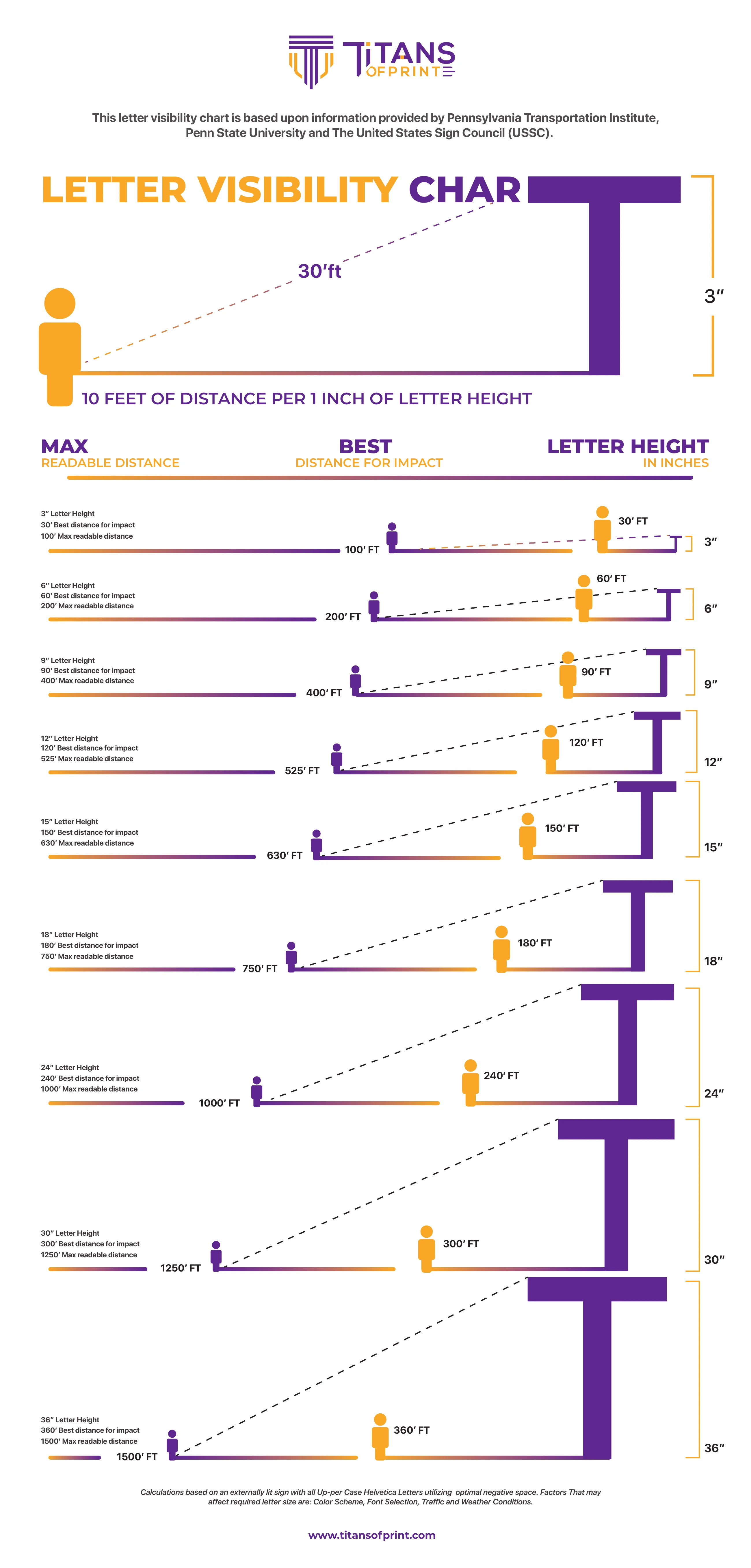
Use the letter visibility chart in our channel-letter guide as a planning aid. Its maximum readable distances describe ideal conditions. A proof placed on a building photograph helps assess proportions, but the final sign should be evaluated against the real viewing distance and property limits.
Useful photos for a first quote
Send the complete building front, the proposed mounting area up close, and the view from the street or parking entrance. Include rough width and height measurements, existing sign and wiring locations, and anything that could block the view.
Distance is about the letters, not the board size
A large panel with a small business name can still be difficult to read. The chart uses about 10 feet of viewing distance per inch of letter height as a starting point for impact: a 6-inch letter at about 60 feet, a 12-inch letter at about 120 feet, and a 24-inch letter at about 240 feet.
Use that starting point for wall panels, cut letters and directional headings as well as channel letters. Secondary text needs its own size check. A moving driver needs quick recognition; do not design the whole sign around the farthest ideal maximum in the chart.
| Letter height | Distance for impact | Ideal maximum |
|---|---|---|
| 3 inches | About 30 feet | 100 feet |
| 6 inches | About 60 feet | 200 feet |
| 9 inches | About 90 feet | 400 feet |
| 12 inches | About 120 feet | 525 feet |
| 15 inches | About 150 feet | 630 feet |
| 18 inches | About 180 feet | 750 feet |
| 24 inches | About 240 feet | 1,000 feet |
| 30 inches | About 300 feet | 1,250 feet |
| 36 inches | About 360 feet | 1,500 feet |
Look at the material up close
PVC, Acrylic, ACP and Metal: What Changes in the Finished Sign?
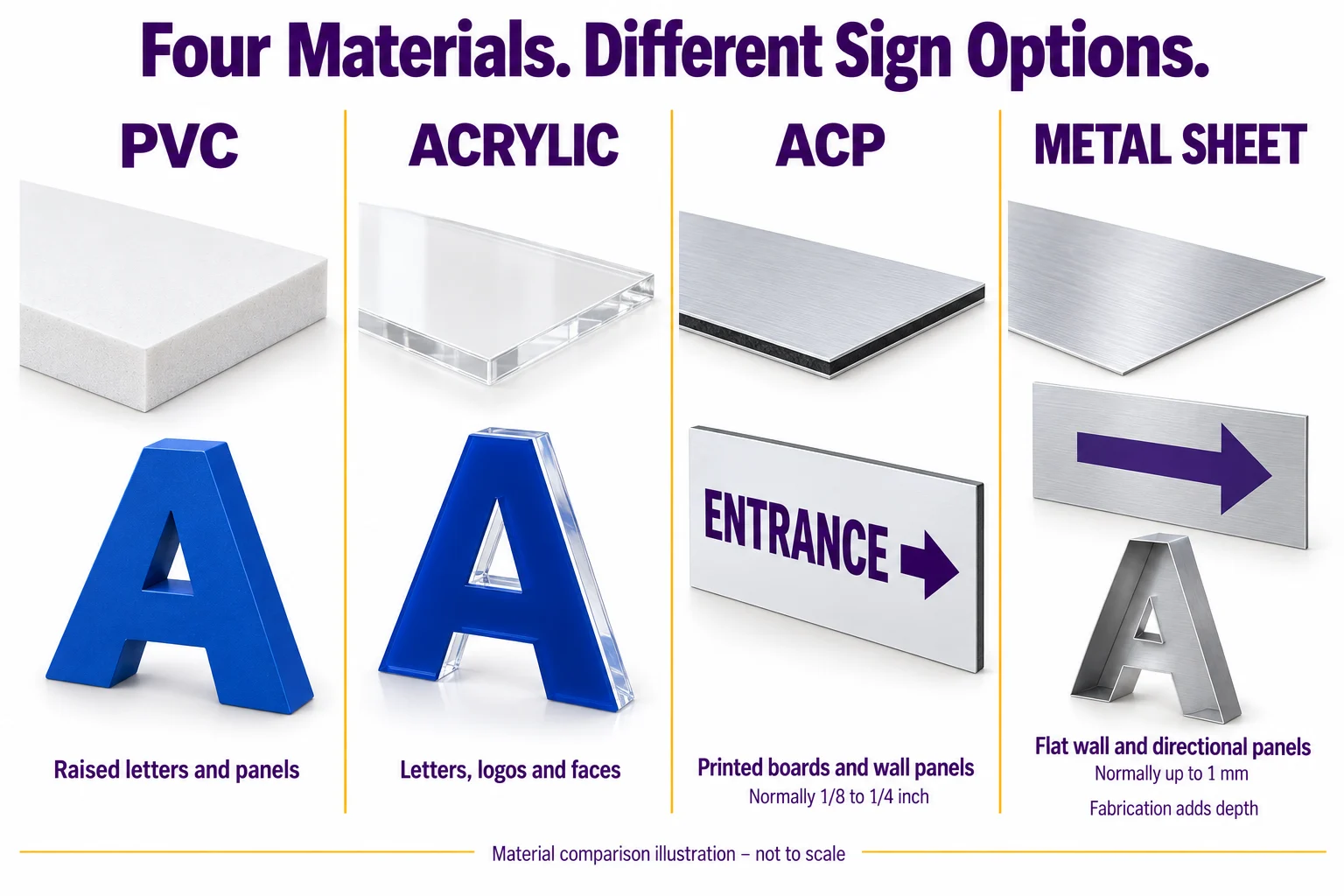
The material is the physical sign; the message and location decide how it should be used. PVC and acrylic can give letters and logos visible depth. An ACP board gives a printed design one continuous background. Thin metal sheet makes a flat panel; fabricating it into a hollow body adds depth. These can also be combined: dimensional letters on a flat panel, for example.
PVC letters and panels
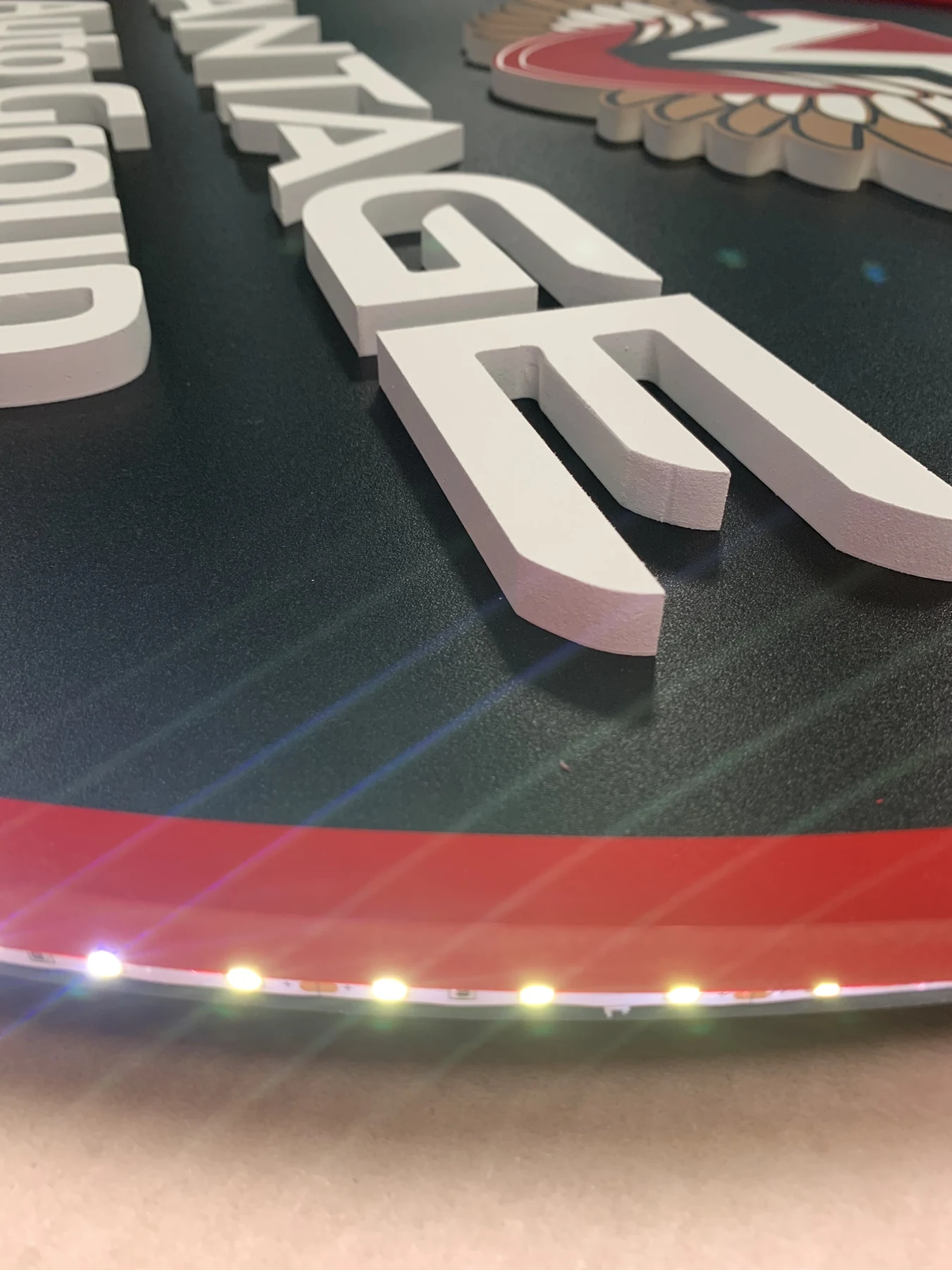
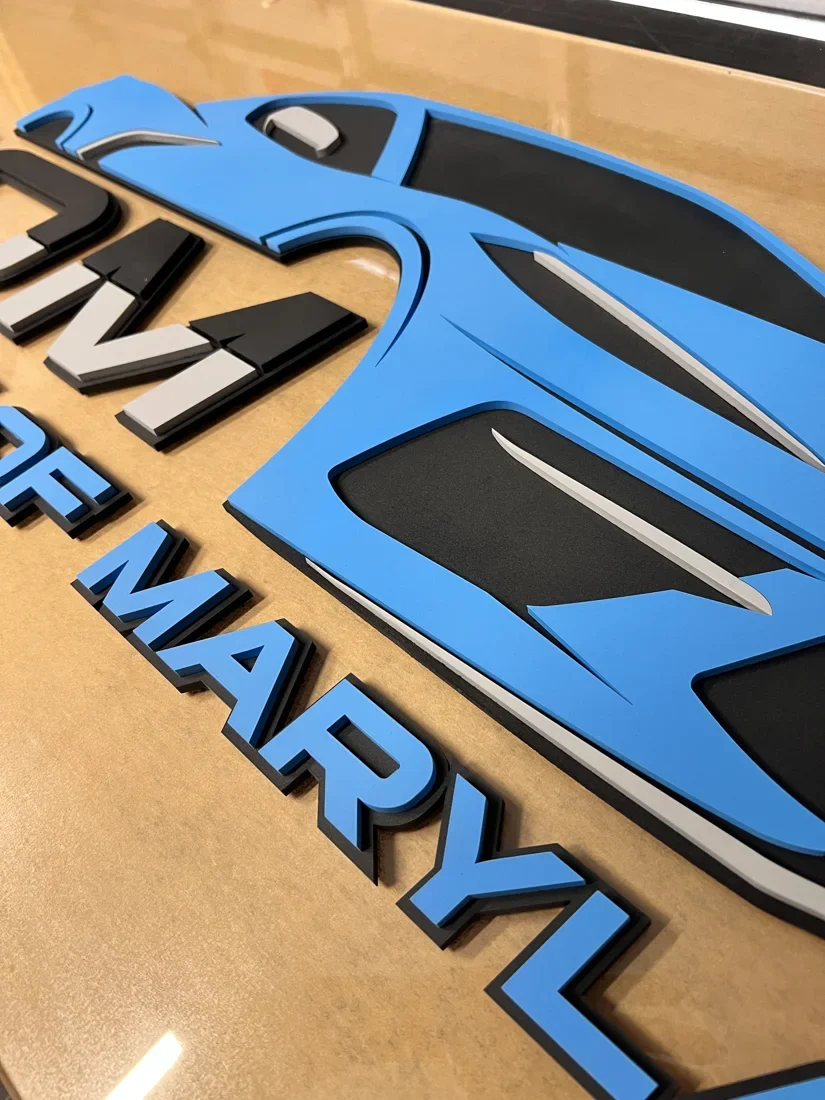
Rigid expanded PVC can be routed into separate letters and logo shapes, or used as a lightweight flat panel. Our PVC sign options include thicknesses from 1/4 inch to 1 inch, depending on the design. A painted face follows the brand color, while the visible sidewall creates the dimensional effect.
For exterior lettering, use a suitable grade, paint system and mounting specification for the exposure. Larger pieces, fine strokes, dark colors and strong sun can change what is practical. PVC is useful when you want a substantial raised logo without the weight of solid metal; it should not be treated as the same product as a solid aluminum letter.
Acrylic letters, logos and sign faces
Acrylic can be clear, colored, painted or layered to follow a logo. Our laser-cut options run from 1/8 inch to 1/2 inch; thicker designs up to 1 inch are CNC routed. A polished clear edge, painted face or stacked color changes the finished appearance.
Acrylic is also used for illuminated sign faces. Choose the face and lighting together: translucent material lets light through, while an opaque or mirrored finish creates a different effect. For an exterior sign, confirm the grade, finish, support and exposure. The material name alone does not determine the mounting or lighting design. Compare more dimensional sign options before choosing the construction.
ACP / aluminum-composite boards
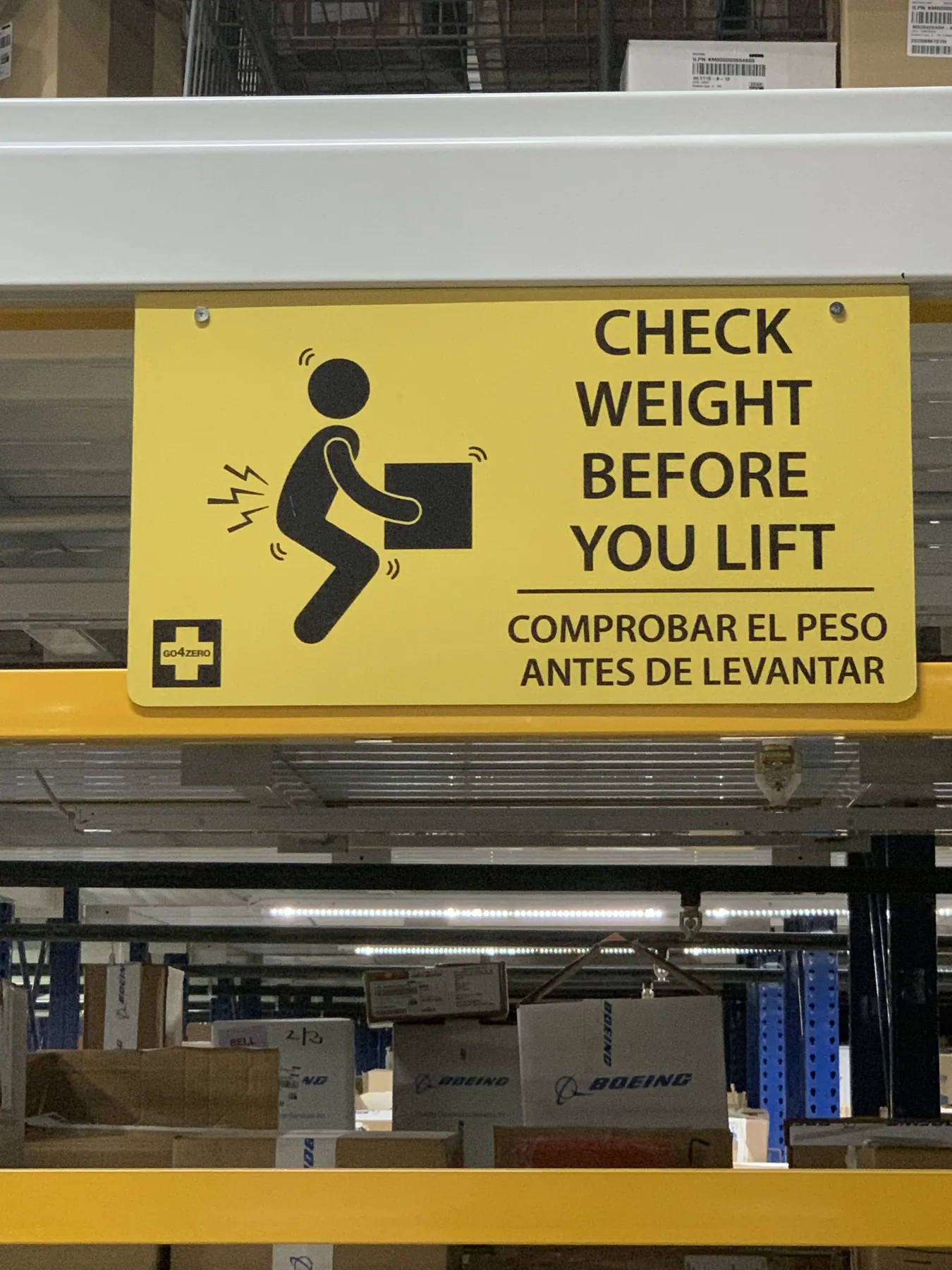
ACP means aluminum composite panel; you may also see ACM, for aluminum composite material. Our ACP sign boards are normally 1/8 inch to 1/4 inch thick overall. They have very thin aluminum skins bonded around a core, rather than being solid metal through the full thickness. The finished edge is slim. The flat face works well for printed graphics, cut vinyl, tenant names and business information.
For an exterior wall board, entrance sign or directional panel, specify the outdoor-suitable sheet and face treatment, finished dimensions, edge finish and support. A larger board may need a frame or back support. The composite core is visible at a cut edge unless the construction covers it; decide whether the edge will be exposed or framed.
Thin metal panels and fabricated signs
For our flat metal sign panels, the sheet is normally up to 1 mm thick. That makes a slim edge, often barely noticeable from the front. A printed or vinyl-faced metal panel works for wall identification, parking information and directions. Its edge comes from the thin sheet rather than a built-up body.
Fabricated letters and signs are a different construction. Thin metal is cut, folded and joined to form a hollow body, so the finished sign has depth without being solid metal throughout. Flat-cut dimensional letters and cast metal are separate options with their own thicknesses and weight. Brushed, painted, polished and suitable anodized finishes create different looks. Specify the construction as well as the material when requesting a quote.
Choose the finish and the face
A rigid board can carry a printed image or applied vinyl; raised letters may be painted, metal-faced or layered. Confirm the actual color reference, finish and surface treatment on the proof. Gloss, matte and brushed faces reflect light differently, and a phone photograph is not a dependable color reference.
HDU and wood offer other dimensional options. Their exterior suitability depends on the chosen material and finish. See our dimensional sign options and metal logo signs for more construction and finish examples.
Choose the attachment with the material
Cut letters, fabricated letters and flat panels do not use the same attachment. Studs, face fasteners, spacers, frames or backer panels change how the sign meets the wall. Stucco, concrete, masonry, metal panels and canopies present different fastening, waterproofing and access questions.
Ask about cleaning and service access too. Include working height, occupied-area restrictions, site contacts and approved working hours. Powered signs also need a suitable wiring path; our LED installation guide explains that separate requirement.
For material construction and outdoor-grade guidance, see 3A Composites on aluminum-composite signage and Plaskolite on PVC sheet grades. Product grades vary; the final specification is selected for your sign.
A Sign Board Is a Complete Product, Not Just a Sheet
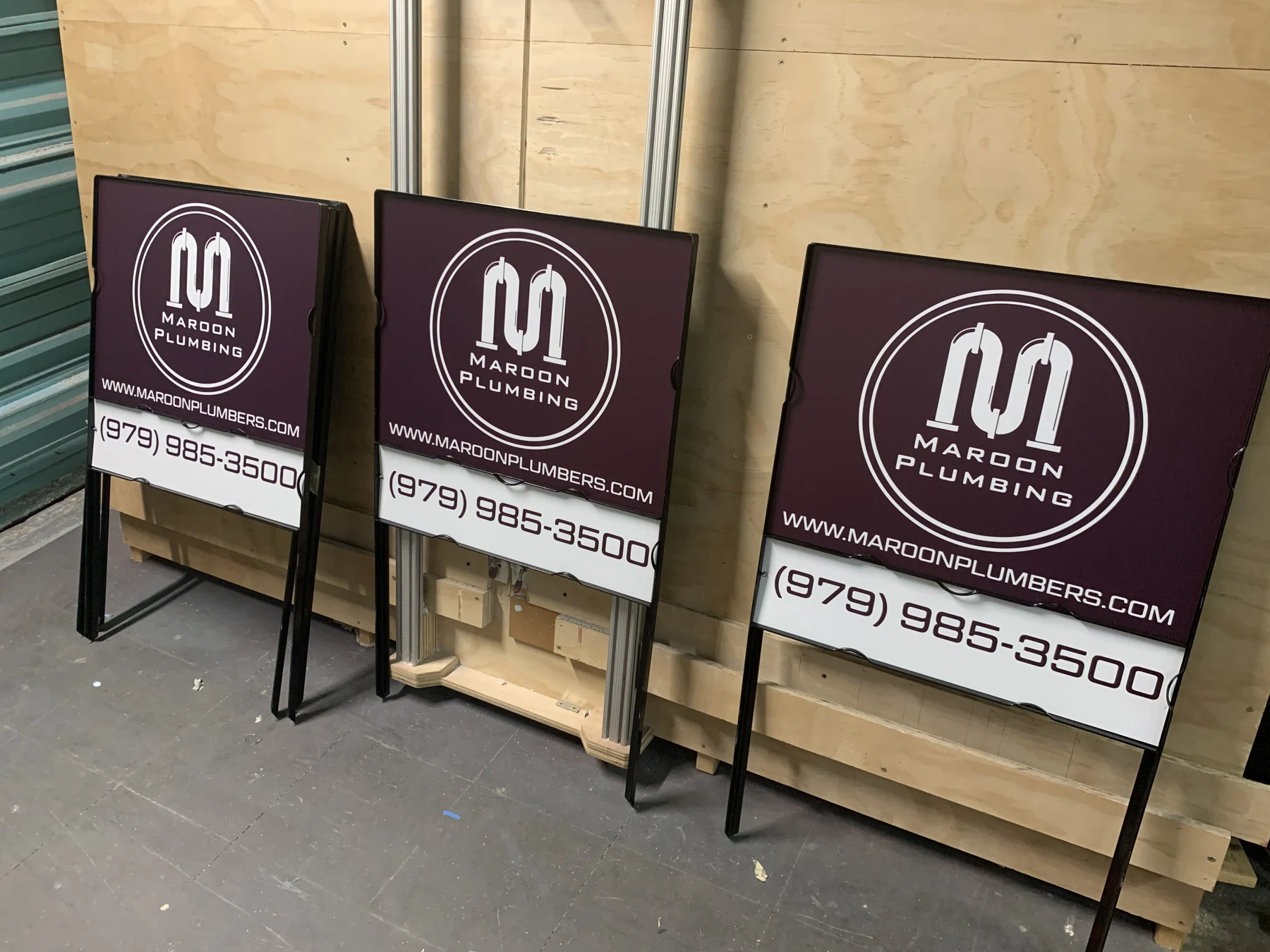
A board puts the entire message on one surface. It can show a business name on a wall, several tenant names, instructions at a gate or a destination near a driveway. The background is useful when brick, textured stucco or multiple paint colors would make separate letters harder to read.
Start with how people approach it. A wall panel is usually read from one side; an entrance board may need a face for each direction. Decide the main message, background color, letter height and whether a logo, arrows or a smaller line of information belongs on the face.
Then specify the physical construction: PVC, ACP or solid aluminum; printed or vinyl face; square or rounded corners; visible or concealed fasteners; and a frame, post system or wall attachment. A thin board should not be assumed to span a large unsupported opening. Panel size and support need to be considered together.
A panel can also act as a backer for raised letters. That gives the logo depth while keeping a consistent background, and can group the components into one installation. Share the available wall width and height, close-up surface photos and any existing frame dimensions so the board and its attachment can be quoted together.
Wall Signs, Directions and Parking: Give Each Sign a Job
The main building name helps people find the property. The smaller signs help them finish the journey: choose the entrance, find the right tenant, park and reach reception or receiving. Using the same colors, type and logo keeps those signs connected without putting every message on the main building sign.
Wall-mounted business and tenant signs
Use raised letters when you want the building wall to remain visible between the characters. Use a flat panel when you need a controlled background, several lines or a layout that can be read as one unit. A dimensional logo on a backer combines both approaches.
For a multi-tenant property, make the tenant naming consistent and plan how a panel can be replaced when a business changes. Keep the entrance or suite identifier easy to see at the point where visitors must choose a door. Coordinate the exterior identity with reception and lobby signs once they come inside.
Directional and delivery signs
Place directions before a turn or decision point. A short destination with a clear arrow is useful for visitor parking, reception, deliveries, receiving and a separate employee entrance. A site plan marked with each sign position helps confirm the message and arrow direction.
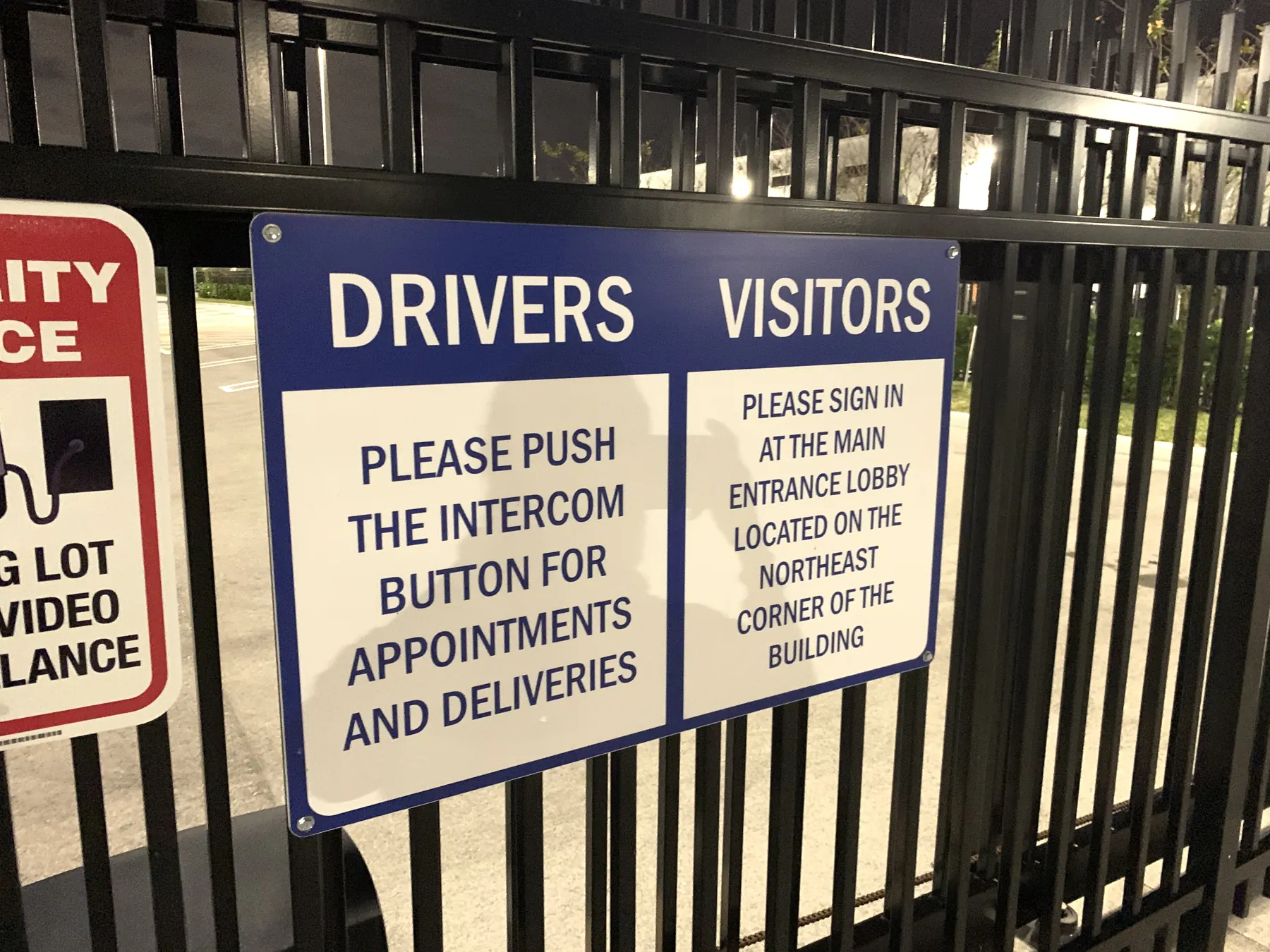
The gate-mounted example separates drivers from visitors and gives each group an instruction. For a faster vehicle approach, simplify the wording and increase the main destination letters. The text size that works while someone is stopped at a gate may be too small across a parking lot.
Parking and property information
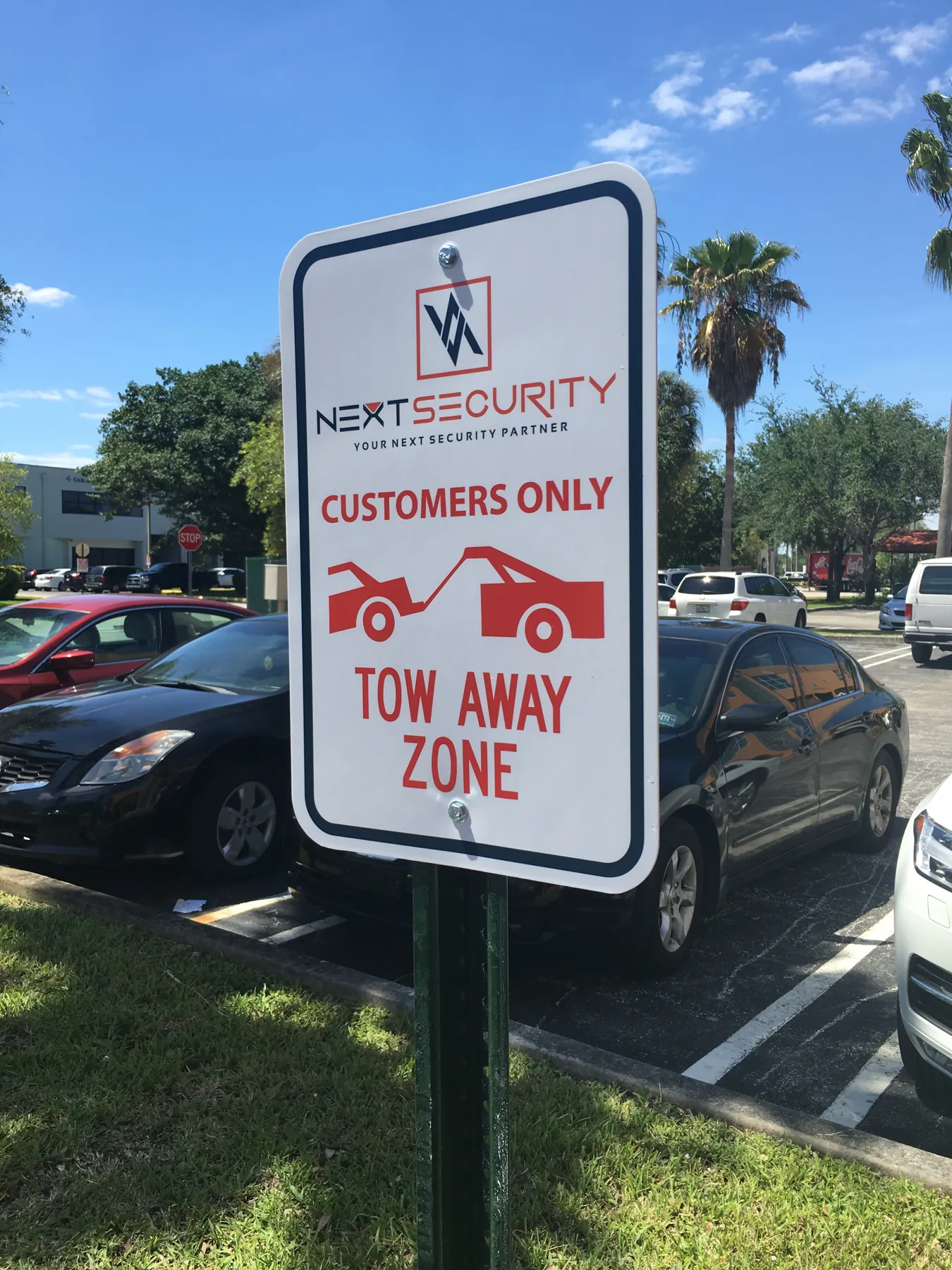
A branded parking panel can identify customer spaces or show property-approved instructions. Separate a long policy message from the main business name. Provide the approved wording, sign count, face dimensions and mounting positions; towing and other regulated messages need the applicable wording and approval for the actual property.
For a complete exterior sign set, send a simple plan showing the street approach, entrances, visitor spaces and delivery route. We can compare the main building identity with the supporting panels rather than quote unrelated pieces in isolation.
Documented exterior examples
Two Different Ways to Identify a Building

E-Com Industry: Raised PVC Building Letters
The Doral-area E-Com Industry project used raised 1-inch PVC letters above the windows as part of a coordinated exterior and interior branding package. It is a useful example of using the wall as the background and giving the logo a dimensional profile.
Read the E-Com Industry case study for the actual building-letter and office-graphics photographs.

AerSale: Building and Entrance Identity
The AerSale project in Doral coordinated illuminated channel-letter branding on the building with a monument sign at the property entrance and an interior logo. The building and monument give visitors two places to recognize the same identity as they arrive.
See the AerSale project photographs and installation details. The full case study includes the nighttime building view and the monument lettering.
What Changes the Cost and Schedule?
The sign format, finished size, number of letters, logo complexity, material, finish and lighting affect production cost. Mounting, removal of an existing sign, electrical work, equipment access, permits and engineering can add separate work. Ask for the quote to identify what is included so the sign and installation are compared together.
For channel letters, many storefront projects start around $2,000 to $5,000, depending on size and letter count. A rough lettering estimate is $20 to $30 per inch of letter height, per letter. Longer names and taller letters increase the estimate. Logos and the other project costs still need confirmation; this is not a price rule for every panel, awning or monument sign.
Allow roughly 3 to 4 weeks or longer for channel-letter production, depending on the approved design, materials and quantity. Permits add approximately 4 to 8 weeks where required. Other sign formats have their own production schedule. Property approval, engineering, review comments, shipping and site access can affect the final date.
Share the planned opening date early. If the permanent sign will take longer, temporary storefront vinyl or a banner may help identify the business while the permanent system is being arranged. Confirm what the property allows before treating a temporary sign as the solution.
Building signage services
Commercial Building Signs: Plan the Whole Property, Not Just One Sign
Commercial building signage usually works as a system: the main building sign, a monument or pylon sign at the drive entrance, tenant panels, door and suite identifiers, window graphics and directions. Our building signage services cover design, proofing, fabrication and installation of those building signs, so every format shares one brand and each sign has a clear job.
Monument and pylon signs
A monument sign is a freestanding sign set low near the entrance or drive. A pylon sign stands on a frame or pole so it can be seen from farther away. Both identify the property before visitors reach the building, and both can be illuminated. Because they are freestanding structures, the location, foundation, engineering and permit requirements are reviewed for the actual site before the design is final.
Metal plaques and dimensional metal letters
Metal letters and plaques suit offices, law firms, schools and public buildings that want a formal, long-lasting identity. Brushed, polished and painted finishes change how the letters read against the wall. Compare constructions on our metal logo signs page.
Multi-tenant and landlord sign criteria
Many commercial properties have landlord or association sign criteria that set the sign area, colors, illumination and mounting. Send those criteria with the quote request so the first proof is designed to them. Plan tenant panels so one can be replaced when a tenant changes without remaking the whole sign.
One approval path for the whole project
Decide who approves the brand, who approves for the property, who coordinates permits and who arranges site access before production begins. Changes are easier while the work is still a proof than after letters, panels or electrical parts are made. Review the proposed signs at scale on photos of the actual building: overall size, smallest strokes, contrast, colors, lighting and mounting.
Ready to price a building sign? Send your building photos, dimensions and logo and we will recommend the sign formats that fit the property.
From Building Photos to a Finished Sign
1. Define the project
Confirm the business name, logo, message, address, sign area and desired result. Include landlord criteria, building photos and any known access or power conditions.
2. Review the proof
Review placement on the actual building elevation, finished size, colors, materials, depth, spacing and mounting. Confirm the current revision with the responsible stakeholders before production.
3. Produce and inspect
Titans prepares the approved construction, reviews the finished sign and confirms the project handoff. Property and permit approvals, when applicable, belong in the schedule.
4. Install or ship
Local installation is planned for the actual site. Suitable completed signs can ship nationwide with appropriate protection, identification, templates, instructions and hardware where appropriate.
Exterior Building Sign Questions
What counts as exterior building signage?
Exterior building signage includes facade-mounted letters, logos, panels, cabinets, and other identification systems intended to be read from outside the property. The correct format depends on the building, approach, artwork, visibility needs, mounting conditions, and approvals.
What should we send for an exterior sign review?
Provide the address, straight-on and approach photographs, approximate sign-area dimensions, current logo files, desired visibility, and any landlord or property criteria. These inputs make the first comparison more specific to the site.
Are channel letters the right choice for every building?
No. Channel letters are useful for many storefronts and commercial facades, but a dimensional logo, panel, cabinet, projecting sign, or coordinated group of signs may fit a different building or customer approach more clearly.
How should exterior-sign visibility be evaluated?
Review the sign from the main approach, not only from directly in front of the wall. Distance, angle, speed, obstructions, mounting height, letter spacing, stroke width, and contrast all influence whether the identity can be recognized.
When should an exterior building sign be illuminated?
Illumination can support evening recognition, but the lighting method should follow the identity and site. Face-lit, halo-lit, edge-lit, and cabinet systems create different appearances and require different construction, electrical, mounting, and service considerations.
Do I need permits for an exterior sign?
Usually, a permanent exterior business sign needs approval before installation. The exact permits depend on the address, sign type, size, placement, mounting and whether it is illuminated. A non-illuminated panel should not be assumed to be exempt. Confirm the requirements with the city or county that handles your property, and get landlord approval separately. Where permits are required, allow approximately 4 to 8 additional weeks; production and property approval have separate schedules.
What affects exterior sign installation scope?
Installation scope depends on the wall, working height, access, delivery route, electrical conditions, occupied areas, approved work periods, and the final sign system. Include site contacts and known restrictions with the project request.
What should an exterior building-sign proof show?
A useful proof should show the current logo, finished scale, placement on the actual elevation, colors and finishes, component relationships, and the intended day or evening appearance. It should also identify the revision that the responsible stakeholders are reviewing.
How much does an exterior building sign cost?
Cost depends on the sign type, size, letter count, materials, lighting and installation. Many channel-letter storefront signs start around $2,000 to $5,000, with larger and longer signs costing more. Panels, awnings, graphics and monuments need their own project estimate. Confirm permits, engineering, electrical work and removal in the quote.
How long should we allow for permits?
Where permits are required, allow approximately 4 to 8 additional weeks. Production and property approval have separate schedules. The final date depends on the sign, address, review comments, engineering and site access.
Find more practical answers in our sign questions and FAQ guides.
For the county process, see Miami-Dade sign permit requirements. Confirm the authority and requirements for your actual property before production.
See How Channel Letters Take Shape
Channel letters are one of the exterior sign options shown in our gallery. This fabrication video shows the product behind the finished illuminated lettering. The preview lets you see what you are opening before you press play.
If an example matches your idea, tell us whether you like its face color, depth, lighting, finish or proportions. We can use those preferences alongside your building photos and measurements.

How Panels and Building Letters Are Installed
Installation follows the sign construction and the property. A small directional board at ground level, a flat panel on a wall and individually mounted letters above a storefront require different supports, equipment and access. We review those conditions before scheduling work.

Wall panels and raised lettering
The mounting surface, sign weight and layout determine the attachment. A panel may use a frame or visible face fasteners; individual letters need their own positions and mounting pattern. Existing sign removal, old holes, wall repairs and nearby obstacles should be identified before work starts.
An elevated sign may require lift access and room to work around a busy entrance. Share pavement conditions, overhead obstructions and property work hours. A powered sign also needs electrical coordination; Titans does not perform the electrical work, which requires a qualified electrician.

Post-mounted boards and directions
An entrance board or parking panel needs a suitable post or frame system, a clear reading position and the right face orientation. The board, supports and connection points must be considered together. Locate it where the message is visible before the visitor needs to turn or park.
Provide existing post and frame measurements when reusing a support. For a new location, confirm the proposed position, ground and access conditions, property approval and any applicable permit or engineering requirements. The finished sign is checked in its intended position, not only on a workshop table.
Installation in South Florida
Titans provides professional sign installation throughout Miami-Dade, Broward and Palm Beach. We review the actual sign, site conditions, access and project responsibilities before scheduling field work. Installation outside South Florida is available by quote, with travel or coordination through an installer as appropriate.
Bring the address, site contact, working height, sign dimensions and known restrictions to the quote. Our sign installation services page explains the broader field-work scope.
Shipping a completed sign
Suitable completed signs can ship nationwide with project-appropriate protection, identification, templates, instructions and hardware where appropriate. Send the best available artwork; Titans can help prepare or repair the file before the proof and production direction are finalized.
Coordinate the building sign with reception and lobby signage, window graphics and commercial sign installation. Separate photos and measurements for each location make a combined project easier to quote.
Exterior Building Signs in Your City
Choose your city for local building-sign information. Bring the actual address and property sign criteria to the quote so the design reflects your site. These pages cover our South Florida market and Orlando.
Get a Quote for Your Building Sign
Tell us what visitors need to see and share your logo, approximate dimensions, property address and target date. Include building and approach photos, finish preferences, any landlord requirements and installation notes.
Latest from Titans of Print
Sign ideas, shop updates and useful tips. Follow @titansofprint on Instagram.

What Customers Say


