




Print bleed might sound like a small detail in graphic design but it decides whether your printed materials look crisp or embarrassingly flawed. A standard print bleed extends designs by just 0.125 inches beyond the final trim size yet prevents every single ugly white border on business cards, brochures, or posters. Most people think all you need is a good file and a pro printer but without bleed your project is always one bad cut away from disaster. This overlooked step is the silent safeguard that separates amateur prints from professional results.
Table of Contents
- Defining Print Bleed: What It Is And Its Purpose
- The Importance Of Print Bleed In Professional Printing
- Understanding The Mechanics Of Print Bleed
- Common Applications Of Print Bleed In Various Industries
- Key Concepts: Trim, Safety Margins, And Color Variations
Quick Summary
| Takeaway | Explanation |
|---|---|
| Incorporate print bleed for edge-to-edge designs | Print bleed is essential for ensuring that colors and images extend to the document edge, preventing unsightly white spaces. |
| Standard bleed is 0.125 inches | This measurement extends design elements beyond the trim line, allowing for precise trimming without visual errors. |
| Print bleed enhances professional quality | Utilizing bleed helps create a polished appearance, essential for maintaining high standards in printed materials. |
| Consider trim and safety zones in design | Establishing safety margins within 0.125 inches of trim lines protects key design elements from being cut. |
| Manage color consistency across prints | Understanding color management enables designers to ensure that colors look the same in prints as they do on screens. |
Defining Print Bleed: What It Is and Its Purpose
Print bleed represents a critical technical process in graphic design and printing that ensures professional quality and seamless visual presentations. At its core, print bleed describes the intentional extension of printed design elements beyond the final trimmed edge of a document or print piece. This technique guarantees that color, images, and background graphics appear perfectly aligned and without unwanted white spaces when the final product is cut to its precise dimensions.
Understanding the Technical Purpose
When designers create materials like brochures, business cards, posters, or marketing collateral, they strategically plan for bleed to prevent unsightly gaps or white borders. The standard bleed allowance is typically 0.125 inches (1/8 inch) beyond the intended final trim size. This extra margin allows printing equipment to print slightly larger than the required dimensions and then precisely trim the excess material, resulting in a clean, professional finish.
Key aspects of print bleed include:
- Ensures complete color coverage to document edges
- Prevents unintended white borders or gaps
- Provides precise trimming flexibility for printing equipment
Why Print Bleed Matters in Professional Printing
Professional printing requires meticulous attention to detail. Without proper bleed, printed materials can look amateurish and poorly executed. Imagine a business card with a slightly misaligned background color or a brochure with thin white lines interrupting a beautiful full-color design. Print bleed eliminates these potential visual disruptions.

Designers and print professionals understand that physical printing processes involve mechanical cutting and slight variations. By extending design elements beyond the trim line, they create a buffer that guarantees a polished, seamless final product. This technique is particularly crucial for full-color prints, photographic reproductions, and designs with complex visual elements that need to appear continuous and uninterrupted.
In practical terms, print bleed acts as a visual insurance policy. It transforms potential printing imperfections into a professional, high-quality output that meets the rigorous standards of modern graphic design and commercial printing.
The Importance of Print Bleed in Professional Printing
Professional printing demands precision and attention to detail, with print bleed serving as a fundamental technique that elevates design quality across various printed materials. By extending graphic elements slightly beyond the final trim line, designers and print professionals create a seamless visual experience that eliminates unsightly white borders and ensures a polished, professional appearance.
Quality Control in Printing Processes
The mechanical process of cutting printed materials introduces inherent variability that can potentially disrupt design integrity. Even with advanced cutting equipment, slight shifts during trimming can result in unintended white edges or misaligned graphics. Print bleed acts as a critical quality control mechanism, providing a buffer zone that guarantees designs appear crisp, continuous, and fully integrated across the entire printed surface.
Key advantages of implementing print bleed include:
- Eliminates potential visual imperfections during trimming
- Ensures consistent color coverage to document edges
- Provides professional-grade finishing for marketing materials
Strategic Applications Across Different Print Mediums
Print bleed proves essential across numerous professional printing applications. Business cards require precise edge-to-edge color representation to convey a polished brand image. Marketing brochures demand continuous background colors and images that extend seamlessly to document edges. Large format prints like posters and signage rely on bleed techniques to create immersive visual experiences without distracting white borders.
Design professionals understand that print bleed transcends mere technical requirement. It represents a sophisticated approach to visual communication, where every millimeter of printed space contributes to the overall aesthetic impact. By strategically planning design elements that extend beyond trim lines, creators transform potential printing limitations into opportunities for visual excellence.
Ultimately, print bleed serves as a fundamental bridge between digital design concepts and physical printed materials. It ensures that the vision captured on a computer screen translates perfectly to the tangible world of printed communication, maintaining design integrity and professional standards across diverse print mediums.
Understanding the Mechanics of Print Bleed
Print bleed represents a sophisticated technical process that bridges the gap between digital design and physical printing. At its fundamental level, bleed mechanics involve strategically extending design elements beyond the final trim dimensions to compensate for inherent mechanical variations in printing and cutting equipment.
The Technical Precision of Bleed Creation
Designers calculate bleed with remarkable precision, typically extending graphic elements 0.125 inches (1/8 inch) beyond the document’s intended final size. This deliberate extra margin creates a critical buffer zone that ensures complete color coverage and eliminates potential white edges during the trimming process. Professional design software provides specific bleed guidelines and measurement tools that help creators accurately prepare their files for printing.
Key technical considerations for bleed mechanics include:
- Precise measurement of extended design elements
- Calculation of trim and safe zones within the document
- Accommodation for mechanical cutting variations
Print Equipment and Bleed Execution
Modern printing equipment utilizes sophisticated cutting mechanisms that work in conjunction with bleed techniques. Large industrial printers first print on oversized sheets, creating designs that extend beyond the final document dimensions. Specialized cutting machinery then precisely trims these sheets, removing the excess material and revealing a perfectly finished print with seamless edge-to-edge coverage.
The interaction between digital design files and physical printing equipment requires intricate coordination. Graphic designers must understand how their digital files translate into physical prints, accounting for potential microscopic shifts during the printing and cutting processes. By intentionally extending design elements, they create a failsafe mechanism that guarantees professional-quality results regardless of minor mechanical variations.
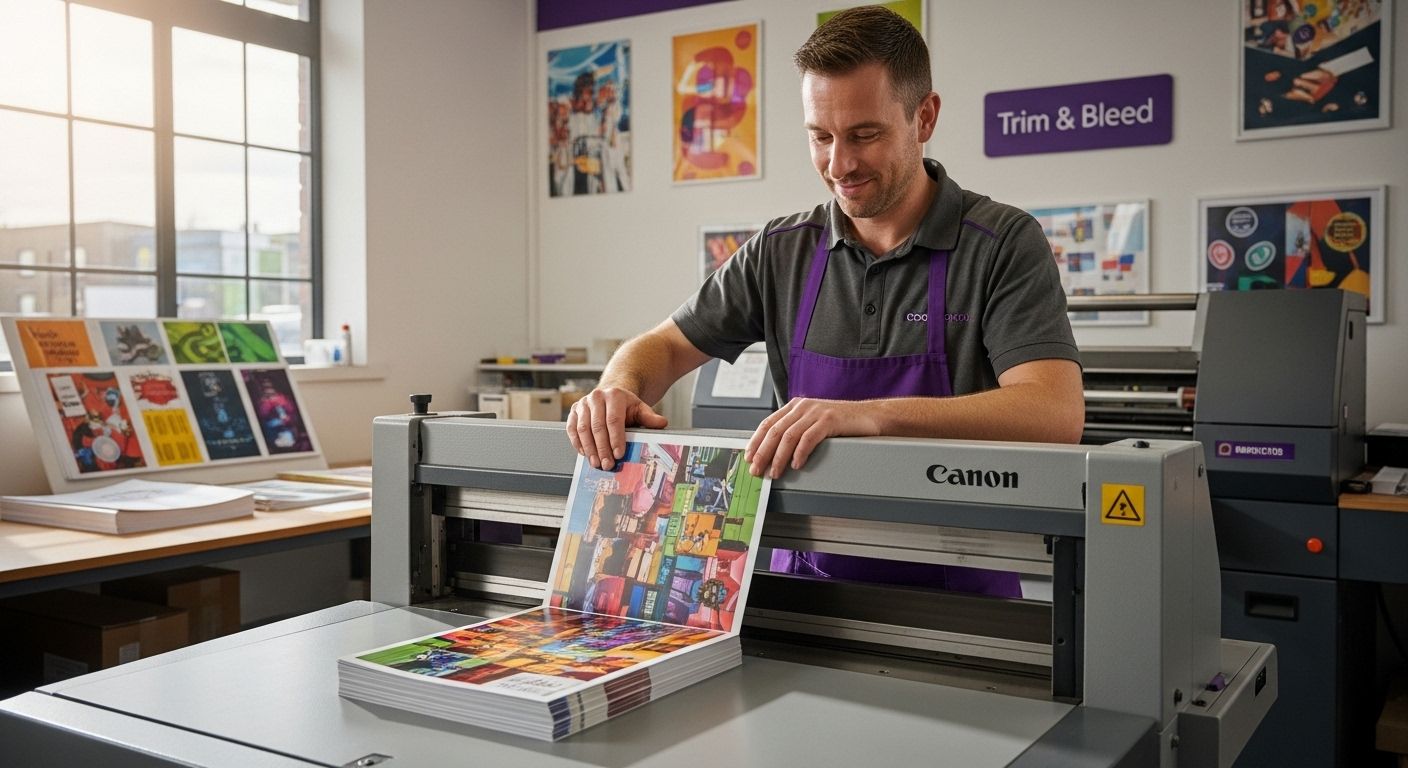
Ultimately, print bleed mechanics represent a nuanced dance between digital creativity and mechanical precision. This technique transforms potential printing limitations into an opportunity for flawless visual presentation, ensuring that every printed piece meets the highest standards of professional design and production.
Common Applications of Print Bleed in Various Industries
Print bleed emerges as a critical technique across diverse professional sectors, transforming how organizations communicate visually through printed materials. From marketing collateral to specialized industrial documentation, bleed techniques ensure high-quality, professional presentations that capture attention and convey information with precision.
Marketing and Branding Materials
Marketing professionals rely extensively on print bleed to create visually striking promotional materials. Business cards, brochures, flyers, and marketing posters demand seamless edge-to-edge design that communicates brand identity effectively. By utilizing bleed techniques, designers can create immersive visual experiences that extend color backgrounds, images, and graphic elements without distracting white borders. explore our guide on professional print design for more insights into creating impactful printed materials.
Key applications in marketing include:
- Corporate brochure design with full-color coverage
- Event promotional materials with edge-to-edge graphics
- Brand identity collateral requiring precise visual presentation
Industrial and Technical Documentation
Beyond traditional marketing, print bleed plays a crucial role in technical and industrial sectors. Architectural plans, engineering schematics, instructional manuals, and technical specifications require precise printing techniques that maintain design integrity. Manufacturing companies, aviation teams, and engineering firms depend on bleed techniques to produce clear, professional documentation that communicates complex information without visual interruptions.
The versatility of print bleed extends to specialized industries such as aerospace, construction, and medical documentation.
The table below outlines common print bleed applications in both marketing and technical fields, highlighting how each industry benefits from adopting print bleed in their materials:
| Industry | Example Materials | Purpose of Print Bleed |
|---|---|---|
| Marketing & Branding | Business cards, brochures, flyers, posters | Seamless color and brand visuals to every edge |
| Events & Promotions | Invitations, event signage, promotional banners | Full-bleed impact, immersive visual presentation |
| Industrial & Technical Documentation | Engineering plans, manuals, technical schematics | Accurate, clear communication without visual interruptions |
| Manufacturing & Construction | Assembly guides, safety instructions, product labels | Ensures readability and professional appearance of technical docs |
| Aerospace/Medical/Engineering | Specification sheets, process charts, compliance docs | Eliminates unwanted white margins for precision and clarity |
Ultimately, print bleed represents more than a technical printing requirement. It serves as a sophisticated communication tool that bridges digital design and physical representation, enabling organizations across various industries to present their visual content with unparalleled precision and impact.
Key Concepts: Trim, Safety Margins, and Color Variations
Understanding print bleed requires mastering three critical technical concepts: trim lines, safety margins, and color consistency. These interconnected elements form the foundation of professional printing, ensuring that designs translate perfectly from digital files to physical printed materials.
Understanding Trim and Safety Zones
Trim lines represent the precise boundaries where printed materials will be cut to their final dimensions. Safety margins create a critical buffer zone within the document where essential design elements remain protected from potential trimming variations. Designers typically establish a safety margin approximately 0.125 inches inside the trim line, ensuring that critical text, logos, and important graphic elements are not accidentally cut during the finishing process.
Key considerations for trim and safety zones include:
- Maintaining minimum 0.125-inch safety margin from trim edges
- Positioning critical text and design elements within safe zones
- Preventing accidental elimination of important visual information
Color Consistency and Printing Variations
Color reproduction presents another complex challenge in professional printing. Digital designs must account for potential variations between screen displays and physical print outputs. Professional designers utilize color management techniques, including color profiles and calibration methods, to ensure consistent color representation across different printing processes and materials.
Color management involves sophisticated considerations such as understanding how different paper stocks, printing technologies, and ink compositions can subtly alter color appearances. Designers must anticipate these potential variations, selecting color palettes and design elements that maintain visual integrity across diverse printing environments.
Ultimately, trim lines, safety margins, and color consistency represent the technical foundation of exceptional print design. By understanding and strategically implementing these concepts, designers transform digital concepts into flawless physical printed materials that communicate visual messages with precision and professional quality.
Below is a table summarizing the differences and purposes of print bleed, trim lines, and safety margins to help clarify these foundational print design concepts:
| Concept | Definition | Purpose |
|---|---|---|
| Print Bleed | Extension of design elements 0.125 inches beyond the trim edge | Ensures color/images reach the edge and prevents white gaps |
| Trim Line | Boundary where final printed material will be cut | Determines finished document size after trimming |
| Safety Margin (Safe Zone) | Buffer area (0.125 inches inside the trim line) where key elements are placed | Protects text/logos from being cut during trimming |
Bring Professional Print Bleed Precision to Your Next Project
If you have ever worried about unwanted white edges ruining your marketing materials or business signage, you know how important print bleed is for a seamless finish. Sloppy trimming or missing margins can quickly turn your bold vision into a missed opportunity. From edge-to-edge color to eliminating unsightly gaps, the right print bleed management creates that polished, professional look you want every time.
Titans of Print understands how crucial these details are. We use the design and production expertise highlighted in the article to ensure your files print perfectly. Secure expert help whether you need custom business cards and flyers or impressive trade show displays and signage guaranteed to grab attention. Do not let technical details get in the way of top-tier results. Visit Titans of Print now and request your quote or consultation. Make your next printed piece stand out for all the right reasons and give your brand the flawless finish it deserves.
Frequently Asked Questions
What is print bleed?
Print bleed is the intentional extension of printed design elements beyond the final trimmed edge of a document, ensuring that colors, images, or graphics align seamlessly without any unwanted white borders when trimmed.
Why is print bleed important in professional printing?
Print bleed is crucial because it eliminates the risk of visual disruptions like white borders and ensures a polished, professional look. It accounts for slight variations that can occur during the trimming process, allowing seamless edge-to-edge designs.
How much bleed should I include in my designs?
Standard print bleed is typically 0.125 inches (1/8 inch) beyond the final trim size. This additional margin helps ensure complete color coverage and prevents any accidental trimming of important design elements.
What factors should I consider when designing for print bleed?
When designing for print bleed, consider the trim lines, safety margins, and color consistency. Ensure critical elements are within safety margins to avoid being cut, and account for potential color variations between digital displays and printed materials.