
Cutler Ridge illuminated signs
LED Channel Letter Signs in Cutler Ridge
South Dixie Highway carries a steady stream of traffic through Cutler Ridge on its way to Homestead and the Keys, and every business along that corridor is competing for a driver's attention at 45 miles an hour. Southland Mall anchors the retail heart of the area, and around it sits a mix of family restaurants, medical offices, auto shops, and service businesses that rebuilt this community almost from scratch after Hurricane Andrew tore through in 1992. That history is not abstract here : it shaped how this stretch of South Miami-Dade gets built, and it shapes how a sign has to be engineered. LED channel letters, illuminated dimensional letters wired with low-voltage LED modules, are the standard for storefront identity along US-1, and Titans of Print, a family-owned sign shop based in Doral, builds them to survive exactly the conditions Cutler Ridge already knows too well.
Choose a glowing front-lit face, a halo behind the letters, or both. Titans designs, fabricates and installs illuminated lettering from its Miami/Doral base. Browse real signs below, compare the construction and face options, then send your logo and property details for a quote.

Get a Quote for Your Cutler Ridge Sign
Send your logo, approximate sign size, property address and target date. Include a photo of the full storefront or building front and any written property sign criteria so we can quote the lettering and mounting together.
Channel Letter Sign Gallery
See real channel-letter signs, including storefronts, building names, logos and raceway installations. If you like an example, tell us whether it is the lighting, color, letter style or mounting that you want for your sign.


Facade planning for businesses in Cutler Ridge
Near the Cutler Ridge Metropolitan Urban Center and Cutler Ridge Park, a plaza tenant may share a sign band with neighboring businesses; a direct street frontage has a different approach. Photograph the center entrance, the tenant bay, and the proposed mounting line. A scale proof can help show the name at the storefront and from the driveway.
Ask the property manager whether the center identity and individual tenant signs use separate locations. Request the current sign package, including approved dimensions, colors, lighting, and mounting details. If a monument or directory sign already identifies the property, include it in the project brief so the tenant sign has a clear role.
Compare letter visibility from the driveway with the close storefront view. Front-lit faces provide direct brightness, halo-lit letters illuminate the wall behind them, and dual-lit combines those effects when the logo allows. Show the proof on a photo of the actual facade, including neighboring tenants and any canopy that may shade the sign.
For a Cutler Ridge quote, provide the property address, suite, artwork, measurements, driveway and storefront photos, target date, and written sign criteria. Mark the tenant bay and proposed mounting area on a simple sketch. Include the property contact and any delivery or contractor-access limits, and list requested survey, permit, electrical, shipping, or installation work.
Coordinate this sign with Cutler Ridge illuminated signs and Cutler Ridge office lobby signs. Share separate dimensions and photos for each location.
Front-Lit, Halo-Lit or Both?
These three lighting styles use different face and back materials. The diagram shows the construction and the effect each one creates. Choose the look you want, then check it against your wall color, available space and landlord’s sign requirements.
Front-lit channel letters
LEDs inside the letter shine through a translucent acrylic face. The face is the bright part you see at night, while the metal sides give the letter its depth. This is a familiar choice for shops, restaurants and showrooms where a name needs to stand out from the road or parking lot.
White acrylic, colored acrylic and translucent vinyl treatments give you different ways to carry your brand colors. Some front-lit letters have a trim cap around the face; the finish and face treatment are part of the approved design.
Reverse-lit or halo-lit letters
These have an opaque face and LEDs that shine toward the wall. Spacing behind the letters lets the light form a halo around the outline. Painted or metal faces remain visible during the day, with a softer glow after dark.
The wall is part of the effect. A smooth, light wall reflects the glow differently from dark brick or textured cladding. The stand-off distance and letter spacing need to work with that surface.
Front and back lit letters
A translucent face and a clear back let the sign light forward and create a halo behind it. You can also combine different lighting treatments within a logo, such as a glowing name with a backlit symbol.
This gives you more control over the nighttime look, but adds lighting and wiring decisions. We show which parts illuminate on the drawing so you can approve the effect before fabrication.
Illuminated office logos
Indoors, a lit logo is usually seen much closer. Letter depth, brightness and the cable route matter beside a reception desk or decorative wall. The same brand can use a smaller interior sign without copying the exterior installation.
For other indoor treatments, compare office lobby signs, edge-lit acrylic signs and custom acrylic signs. LED neon creates a different line of light and is a separate product.

For more lighting examples, see backlit channel letters or our guide to front-lit versus halo-lit signs.
What Color Will the Face Be, Day and Night?
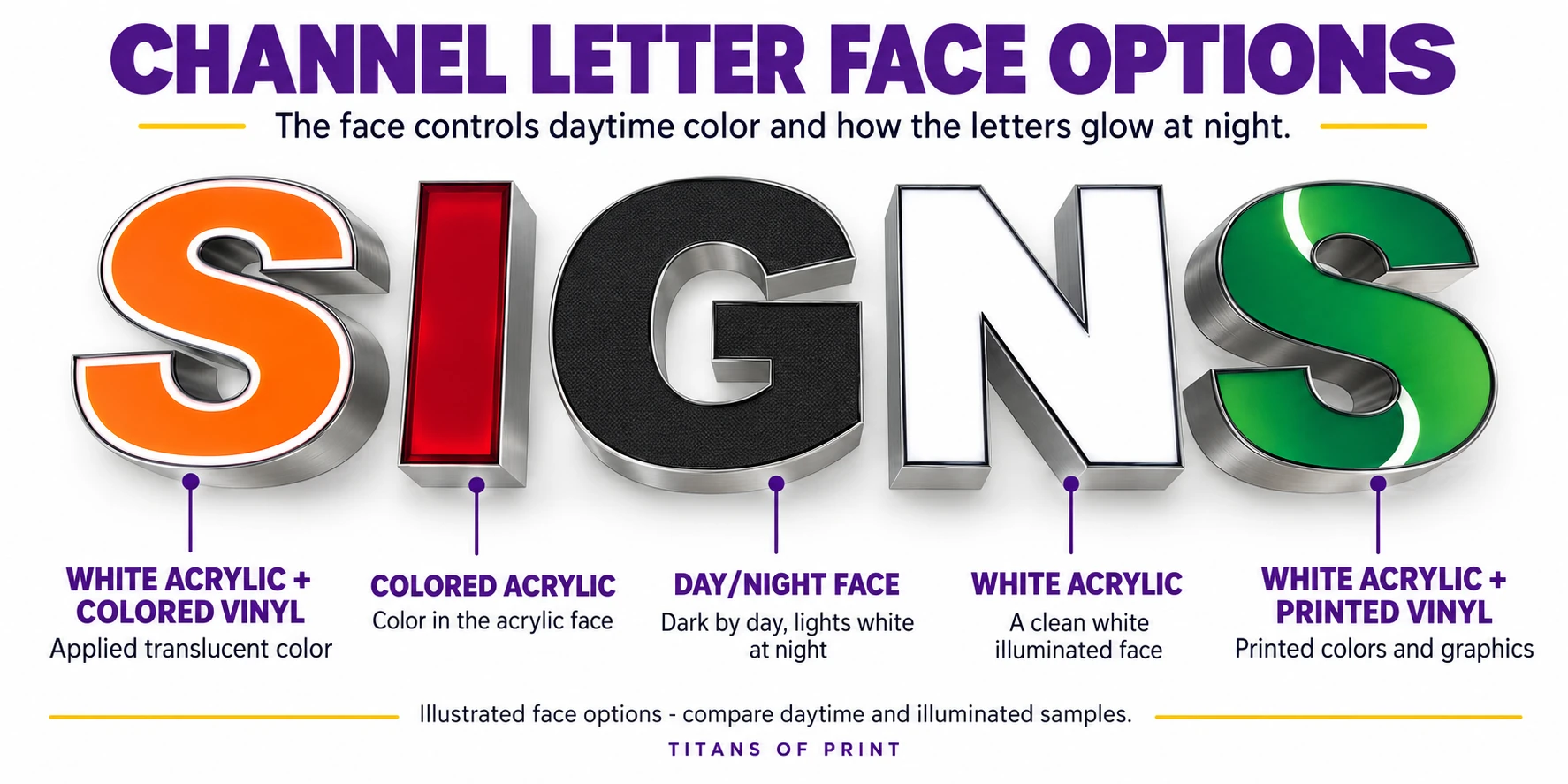
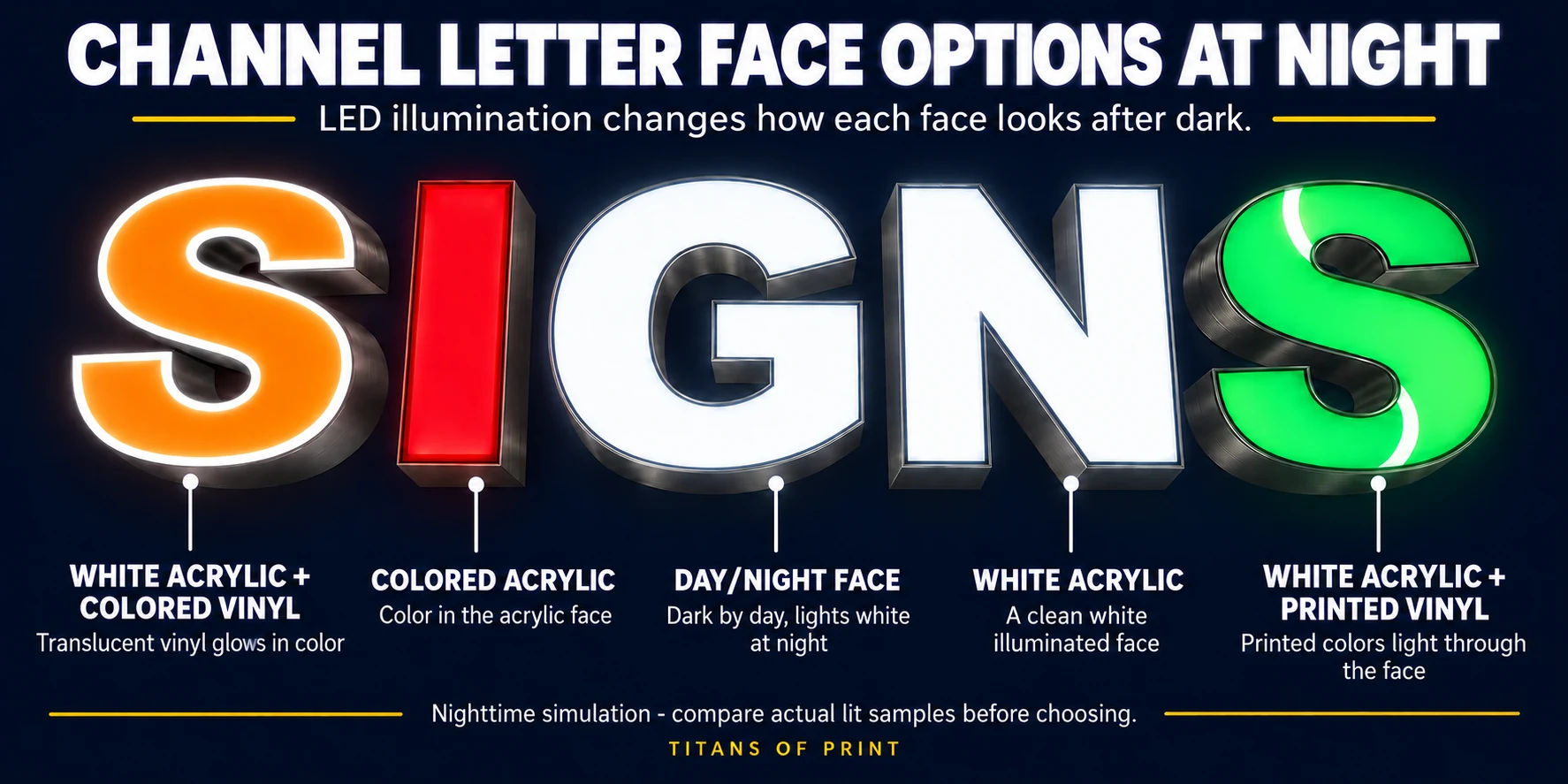
The face is the front surface of a channel letter. It controls the daytime color and how light passes through the sign after dark. The illustrated options below show why the face material deserves its own decision, even when the letter shape stays the same.
Daytime: lights off
Nighttime: LEDs on
White acrylic with colored vinyl
A white translucent acrylic face can carry applied colored vinyl. This gives you a colored face while letting light through it. The original material example shows 3M colored vinyl; the selected film and acrylic should suit an illuminated sign.
Colored acrylic
The color is in the acrylic itself. It can be a good fit when an available acrylic color suits the logo. Check the color both unlit and illuminated, because the glow may look different from a printed brand reference.
Plain white acrylic
A white face gives a clean, bright illuminated letter. It is useful for simple wordmarks and for signs where white lettering provides strong contrast against the building.
Black and white day/night faces
A day/night face is designed to look dark during the day and light up white at night. It gives you an alternative when a black daytime wordmark would otherwise lose its readable face after dark. Ask to see the lit effect alongside the daytime finish.
Printed vinyl on white acrylic
Printed translucent vinyl allows graphics or multiple colors on the face. The original example includes 3M printed vinyl. The print, film and acrylic work together, so we review the illuminated color as well as the daytime artwork.
Bring your brand colors or Pantone references. We help select the closest suitable face and return finishes, with samples or proofs to approve how the sign will look in both conditions.
How Your Channel Letters Are Built
Each letter is a separate three-dimensional body. Aluminum backs and sides, called returns, form the structure. A typical front-lit letter has an acrylic face, LED modules inside and wiring connected to a power supply. With direct mounting, the wall shows through between the letters.
Common construction uses aluminum returns around .040 to .063 inch thick and letter bodies about 3 to 5 inches deep. Depth, face material and the back arrangement can change for a halo-lit or specialty sign. We confirm those details on the drawing for your job.
The LEDs sit inside the letter body, while the face and return finishes carry the brand’s appearance. A clear back can let light reach the wall for a halo effect. Outdoor construction also needs appropriate wiring pass-throughs, sealing and drainage, as shown in the lighting diagram.
From artwork to finished sign
- Approve the design: confirm the wording, logo, size, lighting, colors and mounting position.
- Make the letter bodies: cut the backs and form the returns to the approved shapes.
- Prepare the faces: cut the acrylic or metal and apply the selected face treatment.
- Fit and check the lighting: position the LED modules, route the wiring and test the illuminated effect.
- Prepare for installation: match the letters, mounting hardware and layout template to the agreed installation.
Keep the final drawing and component information with your building records. They make future service and replacement work easier to match to the original sign.
Choose Letter Size for the Distance People Will See It
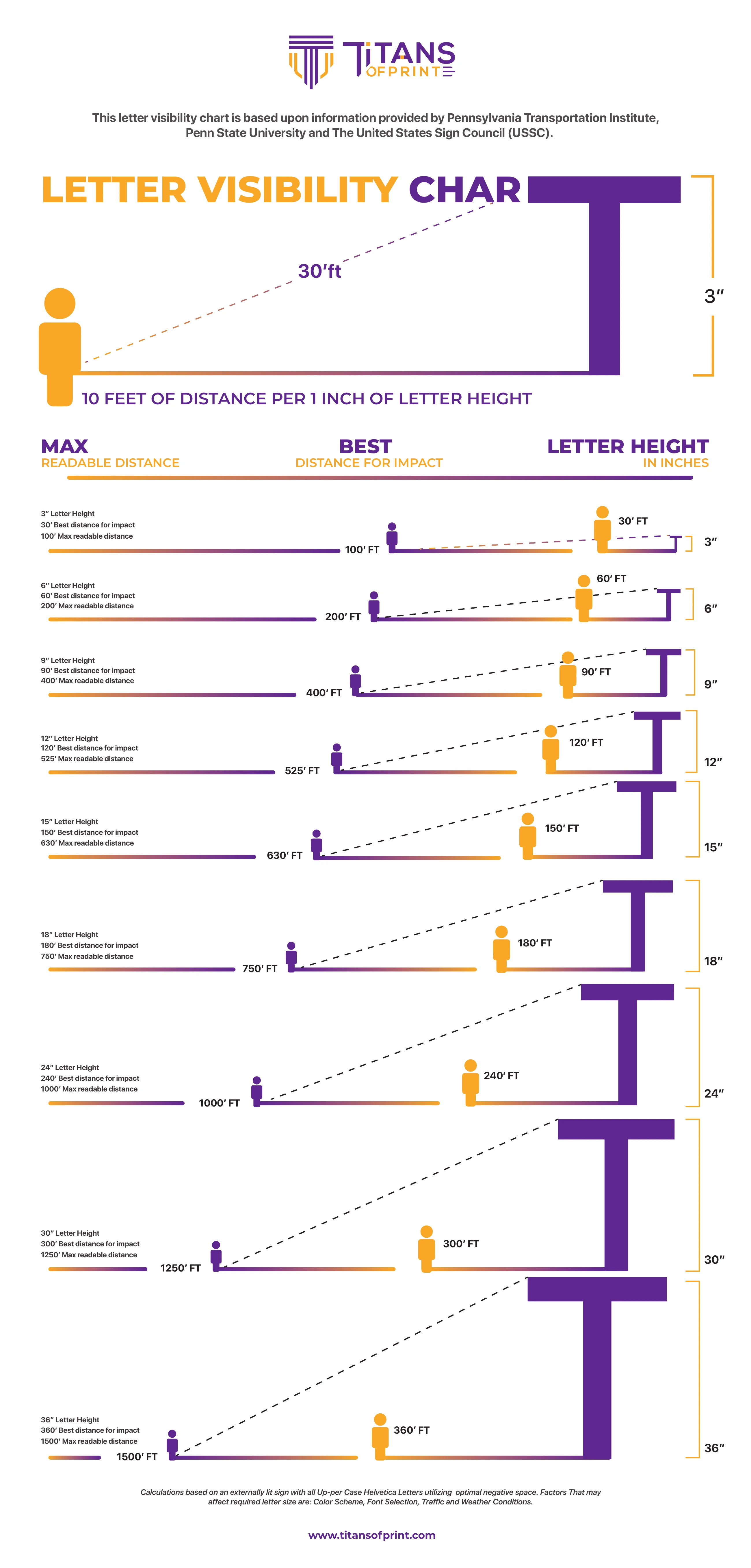
A sign read from a sidewalk needs a different scale from one seen across a parking lot or from a busy road. Start with the distance between your sign and the people you want to reach. Then check the available sign area and the size the property allows.
Our chart uses about 10 feet of viewing distance for each inch of letter height as a starting point for impact. That puts a 12-inch letter at about 120 feet and a 24-inch letter at about 240 feet. Those are planning examples, not guarantees: thin strokes, decorative lettering, poor contrast and an angled view can make the same letters harder to read.
Send a wide photo from the actual approach. We can review letter height, spacing and logo proportions together. Read more in our channel-letter size guide.
| Letter height | Distance for impact | Maximum readable distance |
|---|---|---|
| 3 inches | About 30 feet | 100 feet |
| 6 inches | About 60 feet | 200 feet |
| 9 inches | About 90 feet | 400 feet |
| 12 inches | About 120 feet | 525 feet |
| 15 inches | About 150 feet | 630 feet |
| 18 inches | About 180 feet | 750 feet |
| 24 inches | About 240 feet | 1,000 feet |
| 30 inches | About 300 feet | 1,250 feet |
| 36 inches | About 360 feet | 1,500 feet |
The chart’s longer maximum distances assume favorable conditions and simple uppercase lettering. For a moving driver, quick recognition matters more than being able to work out the name from the farthest possible point. The International Sign Association’s placement guidance also explains how traffic, letter style and viewing conditions change the size needed.
Direct Mounting, a Raceway or Stand-Offs?
Letters mounted directly to the wall
Individual letters attach to the building, with the wiring route planned behind them. This lets the wall remain visible between the letters and keeps a separate mounting enclosure out of the finished view. The wall material and access behind it affect the installation.
Letters mounted on a raceway
A raceway is an enclosure behind the letters that carries wiring and can house the power supply. It lets the sign mount as an assembly through a planned set of fixing points. Some landlords prefer or require it, especially where they want a consistent sign system for tenants.
The raceway can be finished to suit the wall, but it remains a visible part of the sign. Check the landlord’s criteria before choosing direct mounting or a raceway; one method is not required at every property.
Stand-offs for halo lighting
Reverse-lit letters need a gap behind them so the LEDs can shine onto the wall. Studs and stand-offs set that spacing while securing the letters. The right distance depends on the desired glow, the wall and the approved mounting details.
What the raceway diagram shows
The main building-power connection feeds the power supply. Secondary wires run to the LEDs through planned pass-throughs. Mounting holes and the hanger bar support the assembly, while drainage holes help water leave the enclosure.
The pictured 6-inch by 5-inch enclosure and 2-inch hanger bar are example dimensions. Your installation drawing specifies the raceway size, fixing method and electrical arrangement for your sign.

For a replacement sign, include photos of the old fixing and wiring points and tell us whether removal or wall restoration is needed. Our channel-letter installation guide explains the details to gather.
Why Some LED Signs Are Hard to Install
A clean-looking sign still needs a practical wiring route. Separate letters may need several connection paths; a solid wall, a finished ceiling or another occupied room behind the sign can limit where those wires go. A suitable backer or raceway can help organize the connections, but its power feed and future service access still need a plan.
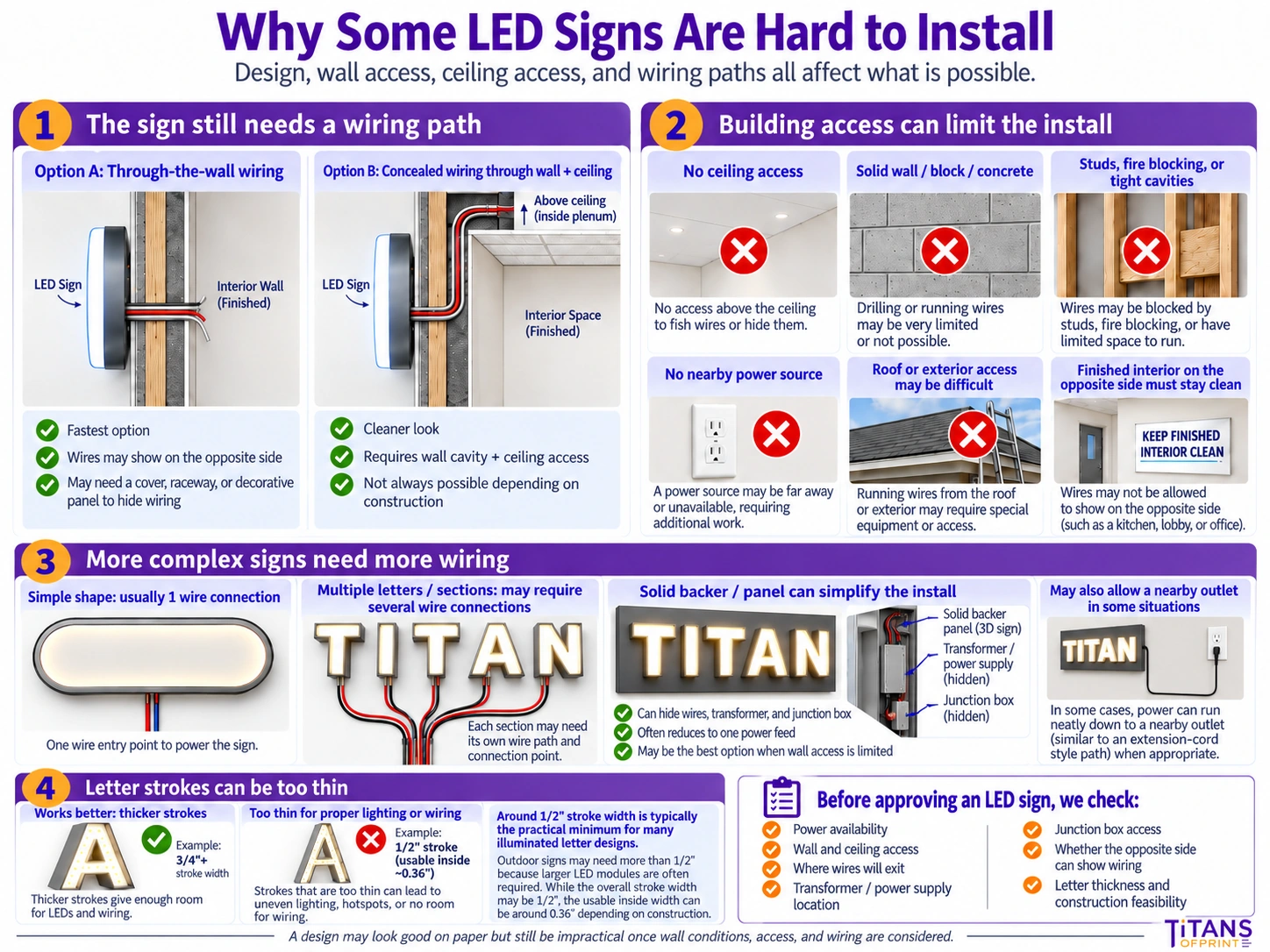
Thin logo strokes also leave less space for LEDs and wiring. The dimensions in the graphic illustrate one construction; the actual module, letter depth and usable cavity determine what fits. Send photos of both sides of the wall, any ceiling access and the known power location with your artwork.
Read the full guide to LED sign wiring, wall access and installation requirements for the options to review before fabrication.
What an LED Channel Letter Sign Is Built From
Each letter in a channel letter set is its own sealed unit, not a cutout mounted to a flat panel. The return : the body of the letter : is formed from aluminum, typically .040 to .063 gauge, running 3 to 5 inches deep depending on letter height. A trim cap seals the edge where the aluminum return meets the acrylic face, and inside that shell sits a row of LED modules tied to a UL-listed low-voltage power supply. There is no gas-filled tubing in any of this; it is a fully sealed electrical assembly, which matters a great deal on a corridor that took a direct hit from a Category 5 storm within living memory.
Because each letter stands on its own rather than sharing a backer panel, the wall or fascia shows through between the letters and the sign reads as part of the building rather than a box bolted onto it. That is why channel letter signs remain the default for storefronts from Southland Mall down through the smaller retail plazas along South Dixie Highway.
The fabrication sequence matters as much as the materials. We start from your logo file and cut it into a working pattern sized to the letter heights the space allows, then form the aluminum returns, route the acrylic faces, and wire each letter before anything ships to the field. A proof goes back to you for sign-off on color, size, and layout before fabrication locks in, so there are no surprises when the crate arrives at the job site. That proofing step matters more on a highway-facing sign than almost anywhere else, because a letter height or color choice that looks fine on a monitor can read completely differently against 40 feet of storefront glass on South Dixie Highway.
Front-Lit and Halo-Lit Options
Front-lit letters use a translucent acrylic face that glows evenly across the whole letter : bright, high-contrast, and easy to read from a moving car, which is exactly the job most Cutler Ridge storefronts need done. Halo-lit (reverse-lit) letters use an opaque face and throw their light backward onto the wall, producing a quieter silhouette-with-glow effect that reads as more upscale. Medical and professional offices in the area tend toward halo lighting, while retail and restaurant tenants along the highway usually want the higher-contrast front-lit look. Our page comparing front-lit and halo-lit channel letters goes through the tradeoffs in more depth, and our backlit channel letter signs page shows the halo effect in our own installed work.
Building for a Corridor That Remembers Hurricane Andrew
Cutler Ridge sits inside Miami-Dade County’s High-Velocity Hurricane Zone, the strictest wind-load code in the country, and this particular stretch of South Dixie Highway is not an abstract case study for why that code exists. Andrew flattened much of South Miami-Dade in 1992, and the rebuilt commercial strips, the reinforced roofs, and the concrete block construction you see today all trace back to that storm. An outdoor illuminated sign here has to be engineered the same way the buildings around it were rebuilt: signed and sealed structural calculations proving the letters, the raceway, and every fastener will stay attached through hurricane-force wind, not just look good on a sunny afternoon.
Permitting for an outdoor sign in this area runs through the Town of Cutler Bay and Miami-Dade County, and that means plan review, a permit, and a field inspection once the sign goes up. We handle the design, the HVHZ engineering, the permit application, and the UL-listed fabrication under one roof, so nothing gets lost in translation between an out-of-state design firm and a local installer who has never pulled a Cutler Bay permit before.
The engineering package itself covers more than just the letters. Miami-Dade plan reviewers want to see wind-load calculations for the letter attachment points, the raceway or mounting hardware, and in many cases the fascia or wall structure it all bolts to. On a building near Southland Mall built or renovated after the post-Andrew code overhaul, that structure is usually solid concrete block or reinforced tie-beam construction designed to those same standards, which simplifies the attachment engineering. On an older strip center that has not been updated, the wall itself sometimes needs additional analysis before a sign can go up on it, which is exactly the kind of detail a shop unfamiliar with this jurisdiction can miss until the permit gets kicked back.
Mounting Along US-1 and in Southland Mall’s Retail Plazas
Most of the commercial buildings fronting South Dixie Highway and surrounding Southland Mall are multi-tenant strip centers and pad sites, and the landlord usually dictates the mounting method. A raceway : a low-profile aluminum enclosure that carries the letters and hides the power supplies and wiring : is the common choice for these leases, since it keeps all the electrical penetrations in one controlled section of the fascia and makes the wall easy to restore when a tenant moves out. Where the fascia and lease allow it, flush mounting individual letters directly to the wall gives a cleaner look with the wiring routed behind the surface. Free-standing pylon and monument tenants set back from the fast-moving highway traffic often pair their channel letters with raceway-mounted cabinets sized for visibility from the road. Our guide to channel letter installation requirements covers how we match the mount to the building.
Reading Day and Night on a Fast Road
A sign on South Dixie Highway has to work in bright Florida daylight and again after dark, often for a driver who has only a few seconds to register it before the next exit or plaza entrance. In daylight, the painted aluminum returns and colored acrylic faces carry your brand as a clean graphic. At night, the LED modules take over and the letters become the sign. We color-match faces to your brand’s exact specification, Pantone references included, so the glow over your Cutler Ridge storefront matches your logo everywhere else. Letter height matters more here than on a slow residential street; a sign meant to be read from highway speed needs larger, simpler letterforms than one meant for a walk-up storefront, which is why we work through sizing the sign correctly before anything is fabricated.
LED service life depends on the specified components, operating conditions and maintenance. They pull a fraction of the electricity that older illuminated signage required and run cool, which keeps the sealed aluminum housing from baking in South Florida summers. That combination of low maintenance and a long service life is a big part of why LED channel letters have become the standard choice for exterior building signage across South Miami-Dade.
Salt-laden air off Biscayne Bay travels further inland than most business owners assume, and Cutler Ridge sits close enough to the coast that it is a real factor in material selection. Painted and anodized aluminum returns resist that corrosion far better than raw or lower-grade metal, and stainless hardware at every fastening point keeps the assembly from weeping rust streaks down a fascia within a year or two. It is a small spec detail that most vendors gloss over, and it is the difference between a sign that still looks new in five years and one that needs a repaint after two.
Matching the Sign to Cutler Ridge’s Business Mix
This is a family-retail and service corridor first. Around Southland Mall and along South Dixie Highway you find national and independent retailers, sit-down and quick-service restaurants, medical and dental offices, auto repair and tire shops, and personal-service businesses that all depend on drive-by visibility rather than foot traffic alone. Retail and restaurant tenants generally want bright front-lit letters sized to be legible from the highway lanes. Medical and professional offices tend to favor a halo-lit or combination treatment that reads as more established without competing with a retail sign next door. Auto and service businesses along the corridor often need larger, simpler letterforms that read clearly from a distance at speed, prioritizing legibility over decorative detail.
Plenty of these same businesses also want the illuminated look inside : a lit reception wall in a medical office, or a lobby sign behind a service counter. Those interior builds pair well with our office lobby signs and non-illuminated metal logo signs for a consistent brand from the parking lot to the front desk. For a slimmer interior treatment, edge-lit LED signs and custom acrylic signs carry the same lit-brand concept at a smaller scale, and our full illuminated business signs lineup covers everything in between.
Cutler Ridge also functions as a gateway rather than a destination for a lot of the traffic that passes through it. Drivers headed south toward Homestead, Florida City, and the Keys, or west toward the Everglades entrances, pass through this corridor without necessarily planning to stop : which means a sign here is often competing for a spontaneous decision, not a planned visit. A restaurant or service business that can be read clearly and quickly from the road has a real shot at converting that pass-through traffic; one that blends into the strip does not. That single fact shapes almost every recommendation we make on letter size, contrast, and lighting style for a client on this stretch of US-1.
Property Approval, Permits and Installation
Confirm the current landlord or property sign criteria before approving the design. They may cover the location, overall size, colors, lighting or mounting method. The applicable permit and engineering requirements depend on the actual address and project.
Titans handles or significantly assists with permitting where required and coordinates survey and engineering needs. Send the written property criteria and the site address so the approval path can be checked. A finished photo is not a substitute for a reviewed mounting plan.
Our business-sign permit guide explains the questions to ask before production. For the local rules, see the Cutler Bay sign permit guide.
Allow time for approvals and site work
Permits add approximately 4 to 8 weeks where required, separate from roughly 3 to 4 weeks or longer for production. Landlord review, engineering, comments and access scheduling can also affect the installation date. Share your opening date early.
A qualified electrician performs electrical work. We coordinate the signage requirements and installation handoff so power location, switching, connection and responsibilities are agreed. Photographs should show the building height, canopy, landscaping, access-equipment space and occupied entrances.
Watch Channel Letters Being Made
See how channel letters take shape in the shop. The fabrication video shows the product behind the finished sign, with a real sign preview before you press play.
When sharing a reference, say what you like about it: the face color, letter depth, lighting effect, mounting or overall proportions. That is more useful than asking for a sign “just like the photo” on a wall with different conditions.

How Much Do Channel Letter Signs Cost?
$2,000 to $5,000 is a useful starting budget for many storefront channel-letter signs. It is not a fixed price: the size and number of letters make a big difference. A longer name needs more letters, and taller letters need more material and lighting. Larger building signs can go above that range.
For a rough letter estimate, you can use $20 to $30 per inch of letter height, per letter. Add the letter heights together, then multiply by that range. Logos, unusual shapes and specialty lighting need their own estimate.
A simple budgeting example
Ten letters, each 12 inches tall, total 120 inches of letter height. At $20 to $30 per inch, that gives an estimated $2,400 to $3,600 for the letter calculation.
The same ten letters at 18 inches total 180 inches, giving $3,600 to $5,400. That is why increasing the height can move a sign beyond an initial $2,000 to $5,000 budget.
These examples help you compare sizes. They are not a complete installed quote. Confirm the logo, lighting, mounting, installation, electrical work, permits and engineering scope before relying on a total.
What else affects the price?
- The length of the business name and the complexity of its logo.
- Front-lit, halo-lit or combined lighting.
- Acrylic face treatments, metal finishes and letter depth.
- Direct mounting, a raceway or a separate backing panel.
- Sign-removal work, wall repairs and access equipment.
- Electrical connection, engineering and permitting needs.
- Quantity, delivery and installation locations.
Production and permit timing
Allow roughly 3 to 4 weeks or longer for production, depending on the approved design, materials and quantity. Permits add another 4 to 8 weeks. We confirm the sequence and installation date for your job so the production estimate is not mistaken for the whole project schedule.
Titans serves Miami-Dade, Broward and Palm Beach and ships signs nationwide. Installation outside South Florida is quoted for the project, with travel or installer coordination as needed.
What to Send for Your Quote
Logo, dimensions and colors
Send the largest available logo file, preferably vector artwork, plus brand colors and approved wording. Include the width and height of the available sign area and a straight-on wall photograph. Tell us the intended viewing distance and whether the sign faces a sidewalk, parking area or road.
Do not use a phone screenshot as the only production reference if a vector master exists. Fine artwork details, outlines and spacing need to remain clear when the sign is fabricated. If the logo needs adaptation, approve that change before production.
The lighting brief
State whether you want a glowing face, a halo, or both. Describe the intended light color and which logo elements should illuminate. Include the wall finish and any existing nighttime lighting near the sign so the proof can be discussed in context.
Address and installation details
Include the exact address, mounting surface, sign height, quantity, target opening date and known property restrictions. Identify who approves the artwork, who provides landlord approval, and who handles the electrical connection.
For a multi-location order, list the measurements and conditions separately for each address. Consistent brand artwork does not make every installation identical. The production specification and logistics should reflect the actual locations.
Review before fabrication
Check spelling, proportions, face and return colors, lighting treatment, dimensions and mounting on the proof. Confirm the current logo version and final approver. Keeping those decisions in one approved drawing reduces ambiguity when the fabrication and installation teams work from it.
Looking After Your Finished Sign
LED channel letters give you an illuminated sign without the glass tubing used in traditional neon. The modules and power supply are selected for the build, and their service needs depend on the components, operating hours and location.
At handover, check the sign in daylight and after dark from the agreed viewing position. Keep the approved drawing, finish references and component information so future maintenance or replacement letters can match the original.
Follow the cleaning advice for the acrylic, vinyl and metal finishes on your sign. Ask about maintenance access and the warranty terms for your build when reviewing the quote.
If a letter or section stops lighting, send photos showing what is affected. The sign-service team and the appropriate qualified trade can review the lighting, connection and access needed for the repair.
Channel Letter Questions
How much do channel letters cost?
Many storefront signs start around $2,000 to $5,000, depending on size and letter count. A rough letter estimate is $20 to $30 per inch of letter height, per letter. Logos, lighting, mounting, installation, electrical work, permits and engineering need to be confirmed in the actual quote.
How long do production and permits take?
Allow roughly 3 to 4 weeks or longer for production, depending on the approved design, materials and quantity. Permits add approximately 4 to 8 weeks where required. Property approval, review comments, engineering and site access can affect the final installation date.
Can Titans install channel letters at my Cutler Ridge property?
Titans serves South Florida and can quote installation for a specific Cutler Ridge site. The proposal depends on address, access, facade, sign structure, electrical scope, and property or approval requirements. Share photos and written property criteria so the team can determine whether a survey or other coordination is needed. The final selection should also match approved artwork and written property criteria.
How should I choose lighting for a Cutler Ridge storefront?
Compare the business name from the actual customer approach, in daylight and after dark. Front-lit, halo-lit, and dual-lit letters create different face and wall effects. Facade color, nearby lighting, viewing distance, brand artwork, and property criteria help determine which treatment suits the project. Include a contact who can answer access and property questions during review.
What information speeds up a Cutler Ridge channel-letter quote?
Send vector or high-resolution artwork, exact wording, desired letter height, facade measurements, day and night photos if available, site address, target date, and property sign criteria. State whether installation, survey, permitting coordination, or shipping is included. A complete brief makes the quoted scope clearer. A complete brief helps confirm the requested site work and schedule assumptions.
Do I need a permit for an LED channel letter sign in Cutler Ridge?
The sign and mounting need to be reviewed for the actual address, building and current property criteria. Outdoor wind-load, structural and permit requirements must be included where applicable. Send the property guidelines and building photos before production; a finished-sign photo does not establish approval for another location.
Can channel letters survive a hurricane in this area?
The sign and mounting need to be reviewed for the actual address, building and current property criteria. Outdoor wind-load, structural and permit requirements must be included where applicable. Send the property guidelines and building photos before production; a finished-sign photo does not establish approval for another location.
What's the difference between front-lit and halo-lit channel letters?
Front-lit letters have a glowing acrylic face built for maximum brightness and highway visibility. Halo-lit letters use an opaque face that casts a soft glow onto the wall behind them, giving a quieter, more upscale look often chosen by medical and professional offices.
How will my sign be mounted on a Southland Mall-area strip center?
Individual wall mounting, a raceway or a backer panel can each suit different buildings. The property criteria, actual wall construction, wiring path, working height and service access determine the choice. Share a full-frontage photo and measurements so the drawing and quote can show the visible support and site work.
Can I use LED channel letters indoors for a medical or retail office?
Yes. Illuminated dimensional letters are a common choice for reception walls and lobby signage. Interior installs skip HVHZ exterior engineering and outdoor permitting, making them typically simpler and less expensive than a facade sign.
Will the letter colors match my brand exactly?
Send the approved master logo and color references. We compare acrylic face treatments, vinyl and return finishes against the artwork. Check both the daytime face and illuminated sample before approval, because the same face can look different when lit. The drawing should identify the selected materials and lighting effect.
Get a Quote for Your Channel Letter Sign
Ready to compare options for your building? Send your artwork, measurements, address and target date below. Include photos and any landlord requirements so we can quote the right sign and installation.
More Channel Letter and Building Sign Information
Latest from Titans of Print
Sign ideas, shop updates and useful tips. Follow @titansofprint on Instagram.

What customers say


