
Cardboard POP Displays & POS Stands for Retail Rollouts
Custom cardboard POP displays and POS stands with fast pop-in assembly, tested shelf capacity, custom sizes, and full-color graphics for retail programs, seasonal promotions, and product launches.
Need a quote?
|
Loading
|
- True Pop-In Design: No complicated build. Open the body, insert shelves, stock product, and place it on the floor.
- Broad Keyword Coverage: Cardboard POP displays, point of purchase displays, POS stands, POS display stands, retail corrugated displays.
- Sturdy E/B Flute Ecoboard: Approx. 4.5 mm hybrid corrugated board balances strength with a cleaner print surface.
- Shelf Capacity: Approx. 35–55 lbs per shelf under evenly distributed load. Heavier or uneven SKUs can be sample tested before production.
- Standard Sizes: Common heights of 44″ or 54″, 11″ depth, and widths from 12″ to 20″.
- Print & Finish: Full-color UV direct print or vinyl application in matte or gloss depending on the look you want.
- Configurations: 3- or 4-shelf units, custom headers, die-cut side panels, and tabletop mini versions.
- Standees & Add-Ons: Character standees, product silhouettes, or mascot pieces can be paired with the display body.
- Ideal Programs: Beverage, snack, CPG, supplements, cosmetics, tech accessories, seasonal marketing, and retail launch campaigns.
- Eco Story: Recyclable corrugated construction with optional reuse strategies when the structure remains sound.
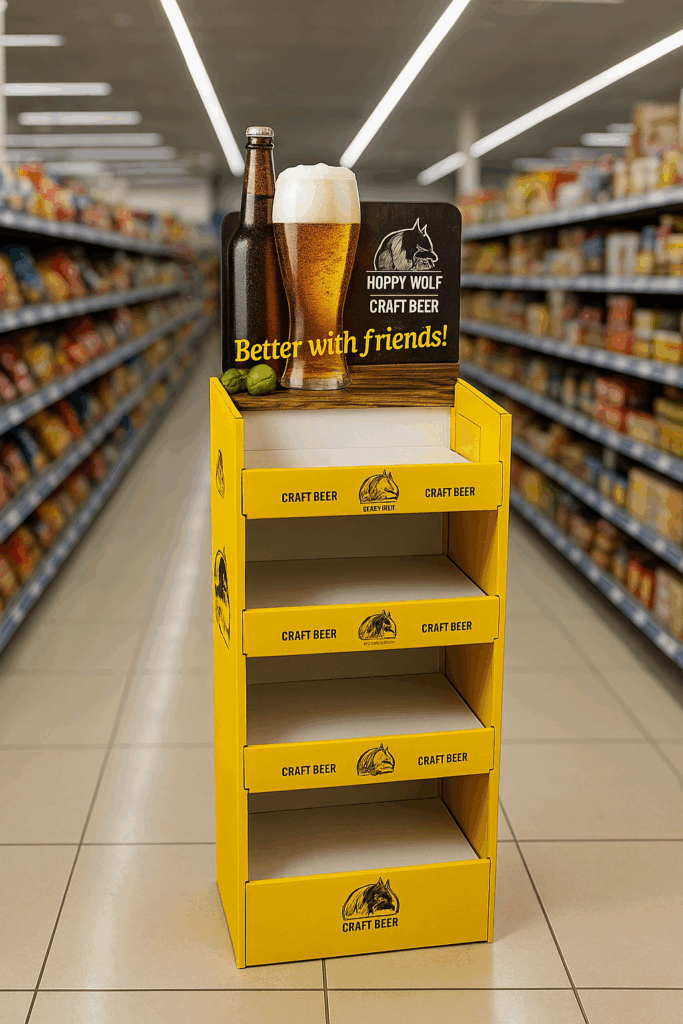 What Are Cardboard POP / POS Displays?
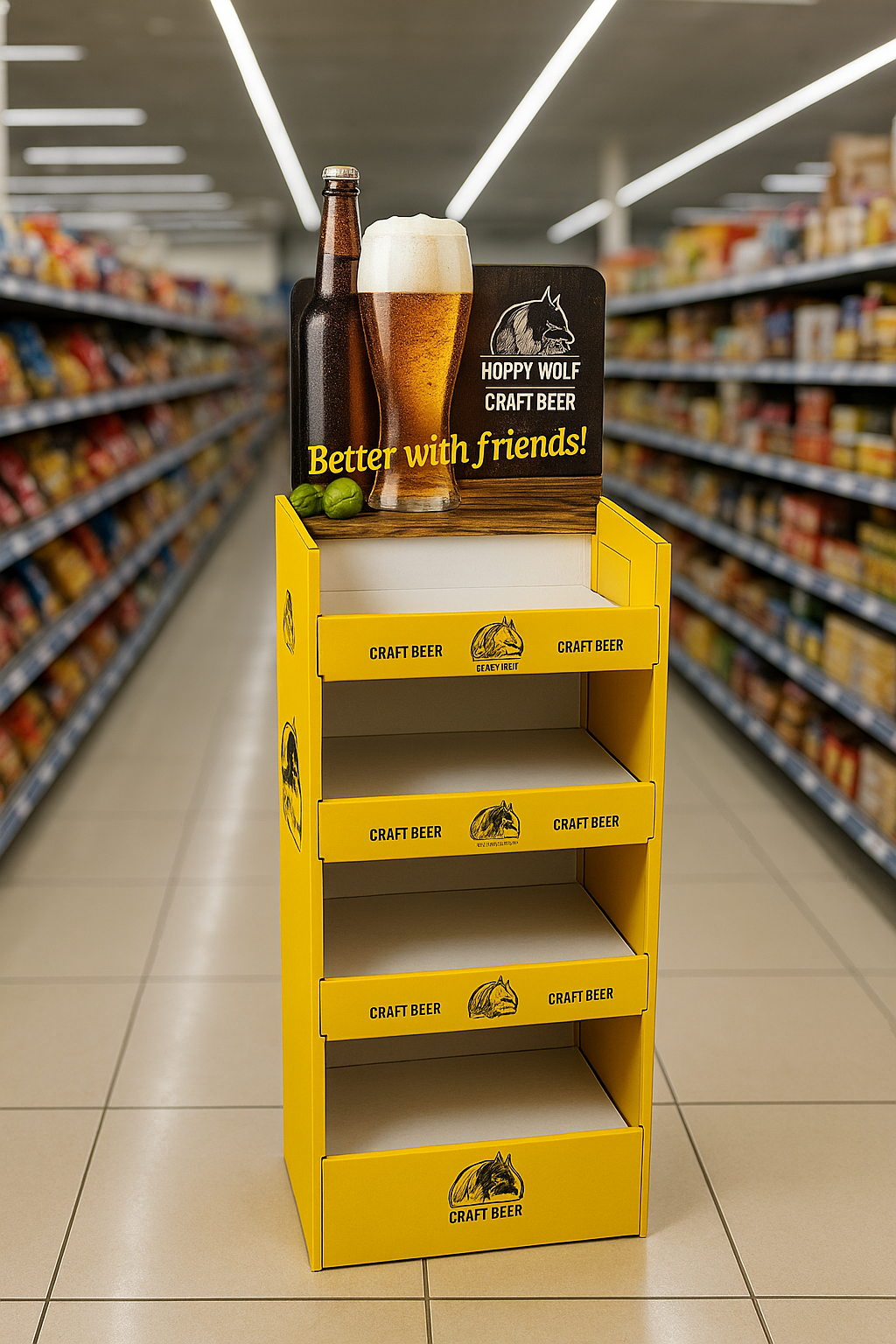
Cardboard POP displays are standalone floor or counter units fabricated from corrugated board and printed for retail merchandising. They are used in places where buyers are already close to making a decision: end caps, aisle interruptions, checkout zones, seasonal corrals, product launch areas, and promotional islands. Because these are point of purchase displays, the whole purpose is to bring the product and the brand message together at the moment of attention.
The term “POS stands” is often used interchangeably, especially when the display sits closer to the register or checkout line. In practice, buyers use several phrases for the same general category: cardboard POP displays, cardboard point of sale displays, POS display stands, retail corrugated displays, and cardboard floor stands. What matters more than the label is whether the structure actually fits the program, the product weight, and the retailer’s expectations.
Our approach is built around fast deployment and structural clarity. Instead of making the setup harder than it needs to be, we focus on bodies that pop open cleanly, shelves that lock the structure into place, and graphics that still look good once the unit is stocked and sitting under store lighting.
- Present SKUs at reachable height.
- Deliver strong vertical branding without needing permanent fixtures.
- Deploy quickly with minimal labor in-store.
That difference matters most when a program has to roll out across multiple doors and the display still needs to look consistent after different store teams set it up.
Why Brands Use Cardboard POP Displays
Retail programs move fast, and floor space is competitive. Cardboard POP displays are often chosen because they combine speed, cost control, print flexibility, and low shipping cube in one structure. A good display does not just hold product. It creates a branded selling surface that can launch a SKU, support a seasonal promotion, organize high-margin impulse items, or give an existing product more visibility than it would get on the shelf alone.
For brands and retailers, the real appeal is practical. The unit ships flat, stores efficiently, goes together quickly, and can be produced with campaign-specific graphics without forcing you into a heavier permanent fixture. That is why they continue to be used across grocery, convenience, beauty, beverage, nutraceutical, and event-driven retail programs.
Built for Real Retail Programs, Not Just Mockups
There is a big difference between a display that looks fine in a render and one that survives stocking, transport, and actual store use. We build these displays with structural performance in mind: flute direction, shelf notch geometry, compression distribution at the base, and how the loaded shelves behave over time. That is where many generic display suppliers get weak.
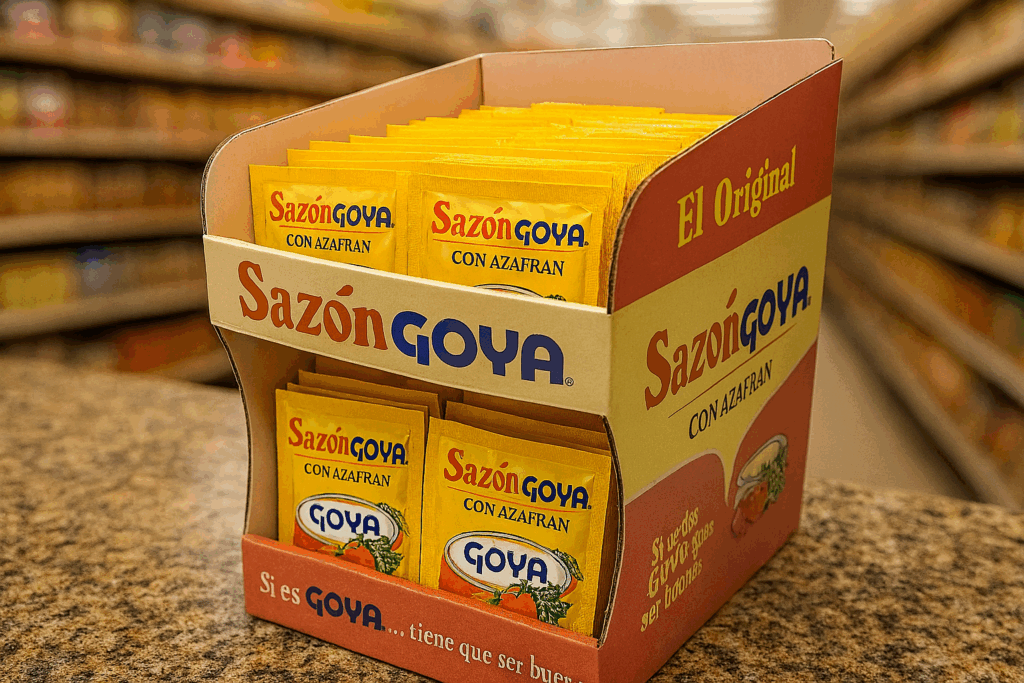
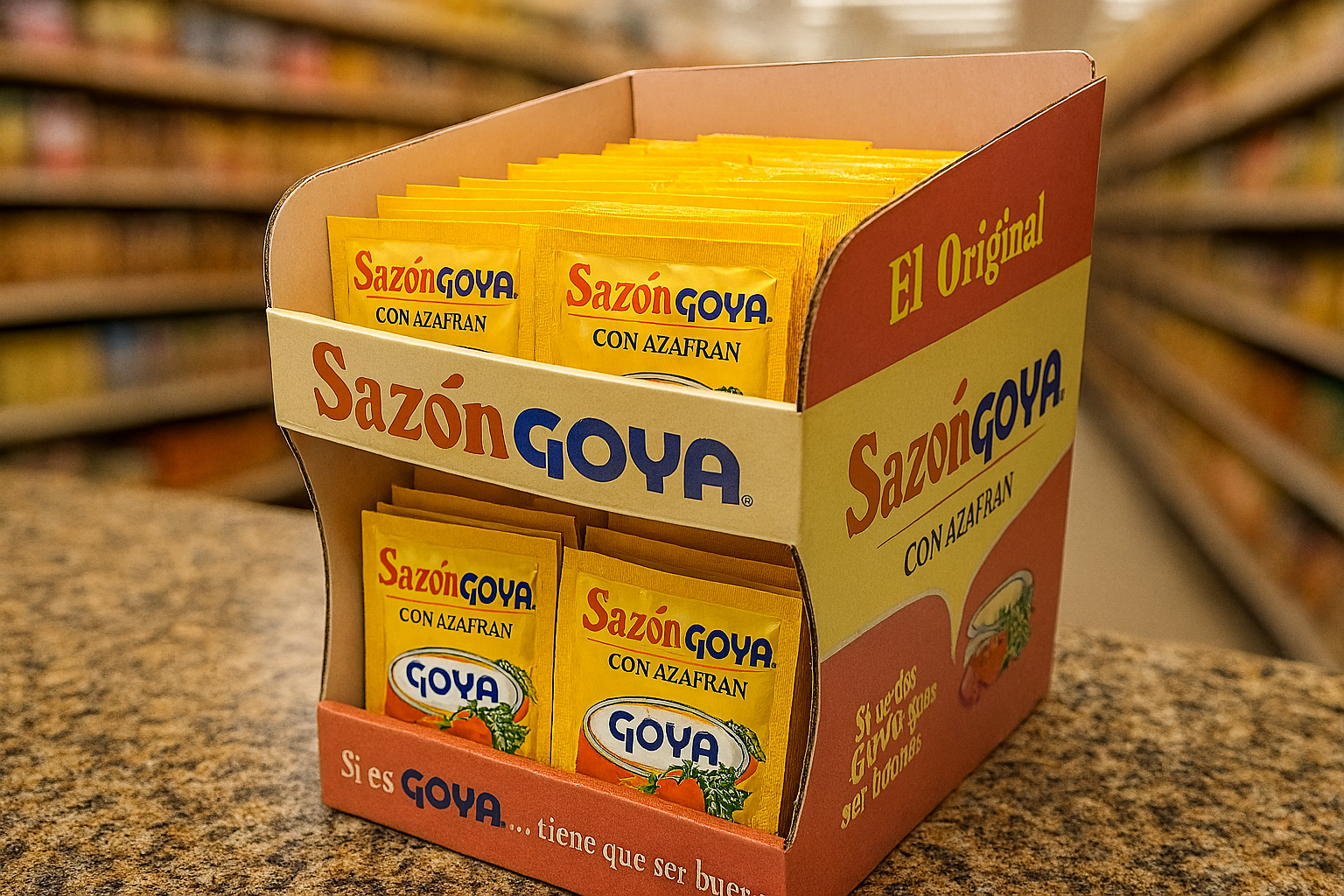
Our broader production experience includes work for recognized names such as Goya and MSC Cruises, along with a wide range of other branded display, print, and merchandising projects. That matters because brands running real programs usually care about more than a pretty concept. They care about rollout speed, consistency, shelf performance, packaging efficiency, and whether the final display still looks right once it reaches the floor.
The Pop-In Advantage: Fast Assembly Without Extra Parts
Many “quick assembly” cardboard displays still require multiple folded gussets, loose fasteners, or too many sequence steps. Our pop-in concept is built to reduce that friction. The body is pre-glued, opens into shape quickly, and the shelf insertion adds rigidity while also finishing the setup.
- Single Motion Expansion: The body opens into shape through pre-glued tension geometry.
- Shelf Locking for Rigidity: Shelf insertion acts as structural bracing from side to side and front to back.
- Lower Labor Demand: Faster setup means store staff can merchandise more units in less time.
- Fewer Assembly Errors: Less tab complexity usually means fewer build mistakes in the field.
- Faster Floor Readiness: Useful for seasonal resets, regional launches, or multi-door execution where lost minutes add up fast.
When a retailer authorizes a program across dozens or hundreds of doors, assembly efficiency affects real compliance. A display that takes too long to build, or is easy to build wrong, often ends up half-set, delayed, or skipped entirely.
Material & Construction: E/B Flute Premium Ecoboard (~4.5 mm)
We use an E/B flute hybrid ecoboard at roughly 4.5 mm thickness because it strikes a practical balance between print quality and structural performance. You get a smoother printable face than a rougher corrugated alternative, while still maintaining the internal strength needed for merchandising loads and everyday store handling.
- Compression Strength: E flute surface quality with B flute internal support.
- Print Fidelity: Cleaner graphics with less flute telegraphing through color areas.
- Edge Rigidity: Better support for shelf loads and more stable structure at the front face and sidewalls.
- Eco Profile: Recyclable corrugated format that still works for short- to medium-term retail promotions.
Corners, shelf slots, and base folds are engineered to distribute downward and torsional forces so a properly loaded display keeps its shape through a promotion cycle instead of sagging early.
Print & Finish Options: UV Direct vs Vinyl (Matte / Gloss)
| Option | Process | Look & Feel | Typical Use Cases | Notes |
|---|---|---|---|---|
| UV Direct Print | Direct ink cure on board | Crisp, fast turnaround, satin look | Higher-volume rollouts, cost-sensitive programs, broad retail launches | A practical choice for most programs |
| Vinyl (Matte) | Printed vinyl applied | Low glare, softer premium feel | Beauty, supplements, wellness, more polished brand presentations | Can help soften flute appearance further |
| Vinyl (Gloss) | Printed vinyl applied | Higher sheen, stronger color pop | Beverage, snack, impulse, high-color seasonal promotions | Works well with saturated palettes |
Need spot gloss, regional versions, retailer-specific compliance notes, or graphic swaps by batch? We can produce versioned sets so the display body stays consistent while the artwork changes by market, language, or campaign wave.
Standard Sizes & Shelf Configurations
| Height | Depth | Width Options | Shelves | Typical Use |
|---|---|---|---|---|
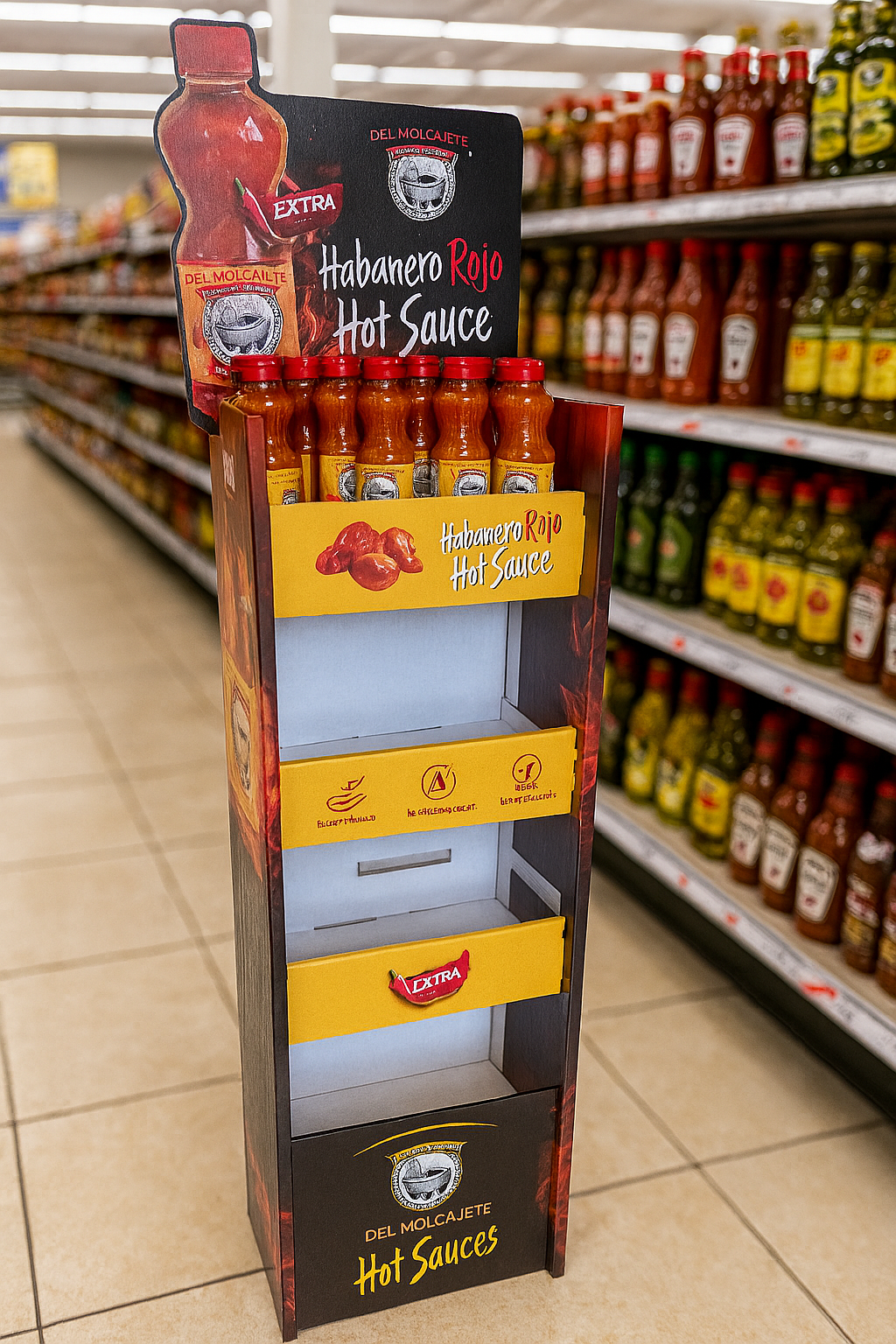
| 44″ | 11″ | 12″, 14″, 16″, 18″, 20″ | 3 or 4 | Counter-adjacent, lower sightline, kid-focused products, compact retail zones |
| 54″ | 11″ | 12″, 14″, 16″, 18″, 20″ | 3 or 4 | Aisle interruption, stronger vertical branding, mid-floor retail placement |
Shelf Load Range: Approx. 35–55 lbs per shelf under evenly distributed product weight.
Weight Disclaimer: For heavier SKUs such as large glass bottles, dense multi-packs, liquids, or uneven-weight products, send sample units. We can prototype and test to confirm safe sustained load and adjust shelf design, flute direction, or reinforcement where needed.
Custom Shapes, Tabletop Minis & Die-Cut Features
Not every retail program needs a standard rectangular floor unit. We also produce:
- Custom Die-Cut Headers: Bottle silhouettes, logos, mascots, seasonal icons, and category-specific top shapes.
- Contour Side Panels: Tapered, curved, or theme-shaped side walls that help the display read more distinctly from the aisle.
- Tabletop Minis / Counter POS Stands: Smaller-format units for checkout zones, service counters, and compact retail spaces.
- Thematic Bases: Wrapped pedestal areas or footer zones with added messaging.
- Branded Standees: Character, mascot, or product standees that can flank or reinforce the main display.
These additions help turn one display into a fuller promotional system without moving all the way into a larger permanent fixture program.
 Assembly in Practice
Typical sequence for one of our cardboard POP displays:
- Unpack: Remove the flat-packed body and shelves.
- Pop Open: The body expands into shape through the pre-glued structure.
- Insert Shelves: The shelves slide into keyed slots and lock the geometry.
- Merchandise: Load product and add any optional header or side components.
A trained staff member can usually deploy a 3-shelf unit in roughly a minute, with extra time only when labels, security devices, or additional attachments are involved. Across a multi-door program, that difference saves real setup time.
Shipping, Storage & Planogram Efficiency
Cardboard POP displays ship flat, which reduces inbound cube compared with rigid display systems. That matters for freight, warehouse handling, and backroom storage.
- Lower Cube: More units per pallet helps reduce per-unit logistics cost.
- Backroom Savings: Minimal storage footprint for future waves, replacements, or partial rollouts.
- Faster Planogram Swaps: Seasonal or promotional transitions become a remove / recycle / pop / restock cycle.
- Versioning Flexibility: Region-specific graphics, compliance notes, or retailer-specific messaging can be printed per batch.
Structural Strength & Product Weight Testing
Even though the format looks simple, structural performance depends on correct flute orientation, shelf lip design, tab landing zones, base compression, and how the product weight is distributed. For high-density or uneven-load items, especially glass bottles or liquid-heavy SKUs, we recommend sample testing instead of guessing.
For heavier programs, our team can:
- Measure sample unit weight and dimensions.
- Load prototype shelves with real product.
- Monitor deflection under time and weight.
- Adjust reinforcement only where necessary so the display stays efficient and cost-aware.
That way the final POS stand is tuned to the actual SKU set rather than a theoretical weight assumption.
 Branding Flexibility & Graphic Refresh Strategy
You can refresh a program without always starting from zero. Depending on the structure and campaign timeline, you may be able to:
- Reprint interchangeable headers for seasonal or wave-based graphics while keeping the core body.
- Produce regional or retailer-specific side panels for local promotions or compliance messaging.
- Add QR codes for recipes, loyalty signups, contest entries, product education, or digital extensions.
- Integrate coupon pads or sample bins through die-cut receptacles where the program calls for them.
This approach helps extend program utility while still giving each wave a fresh graphic identity.
First-Party Proof: Retail & Brand Experience
One weakness on many generic POP display pages is that they explain the format but never show any evidence that the company works with real brands. Our team has produced display, print, and branded environment work for recognized names such as Goya and MSC Cruises. That does not mean every project is identical, but it does show that we are used to handling branded work where presentation, timing, and execution all matter.
Programs like these usually involve more than just printing a box. They require coordination, graphic control, packaging logic, and a clear understanding of how something will be seen in the real world, whether that is in-store, at a branded environment, or as part of a launch campaign.
Ideal Clients & Use Cases
| Segment | How Cardboard POP Displays Help | Examples |
|---|---|---|
| Beverage & Liquor Brands | Launch new flavor or SKU, secure off-shelf real estate, and support short-term promotional placement | RTD cocktails, craft mixers, spirits, beverage launches |
| CPG / Grocery | Promote new pack sizes, bundles, trial programs, or limited editions | Snack multipacks, pantry items, packaged food |
| Health & Beauty / Cosmetics | Support line launches with stronger vertical storytelling and premium finish options | Palette launches, skincare systems, promotional beauty sets |
| Nutraceuticals / Supplements | Use panels and QR codes to educate while keeping the footprint compact | Protein shots, immunity products, wellness bundles |
| Pet Supplies | Highlight premium treats, trial packs, and seasonal assortments | Treat launches, pet impulse packs |
| Tech Accessories | Organize higher-margin impulse items near electronics or checkout areas | Charging cables, cases, adapters |
| Confectionery / Impulse | Drive last-second add-ons near checkout or queue zones | Holiday candy, seasonal confectionery |
| Publishing / Media / Gaming | Pair product with character standees or themed contour shapes | Game launches, comic releases, tie-ins |
| Event & Trade Sampling | Portable branded units for in-store demos and product sampling | Beverage tasting, snack sampling, promo tables |
| Seasonal & Holiday | Quick deployment, easier removal, and clear campaign branding | Back-to-school, summer promos, Valentine’s programs |
Food and beverage brands especially benefit when they need strong vertical brand color, easy assembly, and enough shelf strength to hold real product without moving into a heavier fixture category.
Sustainability & End-of-Life Considerations
Cardboard point of purchase displays use recyclable corrugated, which makes them practical for campaigns that need impact without committing to long-term fixture storage. Post-promotion, the usual process is straightforward:
- Remove any non-paper accessories if used.
- Flatten the structure for standard cardboard recycling.
- Reuse modular elements such as headers where appropriate and structurally sound.
- Avoid reverse logistics unless the economics actually make sense for the program.
We can also discuss FSC sourcing or recycled content goals when the project needs to align with internal sustainability reporting.
Display Alternative – Feature Comparison
| Feature | Our Pop-In Cardboard POP Displays | Typical Multi-Piece Cardboard Display | Generic Die-Cut Kit (Tabs/Slots) |
|---|---|---|---|
| Assembly | Pop open + insert shelves | Multiple panels + more steps | Sequential folding and tabbing |
| Tools / Fasteners | None | Possible clips or supports | None, but more folding complexity |
| Shelf Load (Approx.) | 35–55 lbs (test for heavy) | Varies, often lower per shelf | Lower to mid depending on design |
| Material | E/B flute hybrid (4.5 mm) | Standard single-wall | Varies, often lighter single flute |
| Custom Shapes | Headers, sides, standees | Sometimes limited | Limited as die complexity rises |
| Print Methods | UV or vinyl (matte/gloss) | Usually direct print only | Direct print only |
| Setup Speed | Approx. 1 minute | Several minutes | Several minutes |
| Sample Testing | Offered for heavy SKUs | Less common | Rare |
We focus on being an easy and fast display alternative by combining quick assembly with structural clarity, flexible graphics, and a more realistic shelf-performance conversation than many generic display pages provide.
When to Move Up to Larger Modular / Trade Show Systems
Cardboard POP displays are a strong fit for short- to medium-term retail programs. Consider moving up to a modular or semi-permanent system when the project needs:
- Integrated lighting and shelving beyond corrugated capability
- Long-cycle reuse across many months or repeated events
- Larger branded environments or experiential footprint
A practical approach for some brands is to launch with corrugated POP first, learn from the market response, and then move into a more permanent format once the program proves itself.
Ordering Workflow & Custom Engineering
- Discovery: Share goals, SKU weights, distribution count, and target in-store date.
- Design & Structural CAD: We build the dieline and can work from your artwork or help develop the creative direction.
- Prototype if Needed: Physical samples can be built for fit, shelf testing, and approval.
- Print & Convert: UV direct or vinyl finish, die-cutting, folding, and gluing.
- Pack & Ship: Flat cartons or kitted multi-packs with instructions.
- Deployment Support: Simple pictorial steps or labeled 1-2-3 guidance for faster rollout.
Rush capacity may be available, but the earlier we know your launch date, the easier it is to schedule intelligently.
Pricing Considerations (General Guidance)
Because cost depends on print method, run size, versioning, and structural complexity, we quote by program. The main cost drivers are:
- Quantity: More units spread setup and tooling more efficiently.
- Graphic Version Count: Multiple versions usually increase production complexity.
- Print Method: Vinyl adds material and labor compared with direct print.
- Custom Shapes / Standees: Added die work and sheet usage can affect cost.
- Reinforcement: Only used when the product actually requires it.
For a faster estimate, send version count, store count, desired in-store date, and any heavy-SKU notes up front.
FAQs (Cardboard POP Displays / POS Stands)
Are cardboard POP displays the same as POS stands?
Generally yes. “POS stands” usually refers to point of sale placement near checkout, while “cardboard POP displays” can sit anywhere in-store. Both are corrugated merchandising units.
How much weight can each shelf hold?
Typical tested range is about 35–55 lbs per shelf under evenly distributed load. Heavy or uneven products should be sample tested for confirmation.
How fast can I assemble a pop-in cardboard POP display?
A trained staff member can usually pop open the body and insert the shelves in roughly a minute.
Can I reuse a cardboard point of purchase display?
Yes, if the structure remains sound. Headers or side panels can sometimes be refreshed with new graphics instead of replacing the whole unit.
What is the difference between UV direct print and vinyl wrapping?
UV direct print cures ink directly on the board for speed and efficiency. Vinyl wrap adds a printed film that offers gloss or matte finish options and can further reduce visible flute texture.
Can I order custom shapes or a branded standee with my POS stands?
Yes. We produce die-cut contours, dimensional headers, and full standees that pair with cardboard POP displays for added visual impact.
Are cardboard POP displays recyclable?
The corrugated portions are recyclable through standard cardboard recycling streams once non-paper accessories are removed.
How do I start a custom project or test heavy products?
Provide product samples with weights and desired shelf configuration. We can prototype and load test before full production.
Get a Custom Quote or Prototype
Ready to roll out cardboard POP displays for a retail program, seasonal promotion, or product launch? Share your product specs, store count, timing, and any special shape or standee concepts. Need confidence on heavier SKUs? Send samples for a test build before production.
Areas we setup for you: Kendall, Pinecrest, South Miami, Coral Gables, Kendall Lakes, Sweetwater, Palmetto Bay, Cutler Bay, Homestead, Florida City, The Keys, Key Biscayne, Downtown Miami, South Beach, Miami Beach, Boca Raton, Doral, Miami Springs, Miami Gardens, Brickell, Hialeah, Miami Lakes, Miami, Palm Springs, North Miami, Miramar, Pembroke Pines, Aventura, Hollywood, Davie, Weston, Plantation, Sunrise, Fort Lauderdale, Wynwood, Pompano Beach and all of South Florida areas.
Not local? We can ship it to you, send instructions, a template, show a video and help you through the process.
Share with #titansofprint
Follow @titansofprint for inspiration.

