


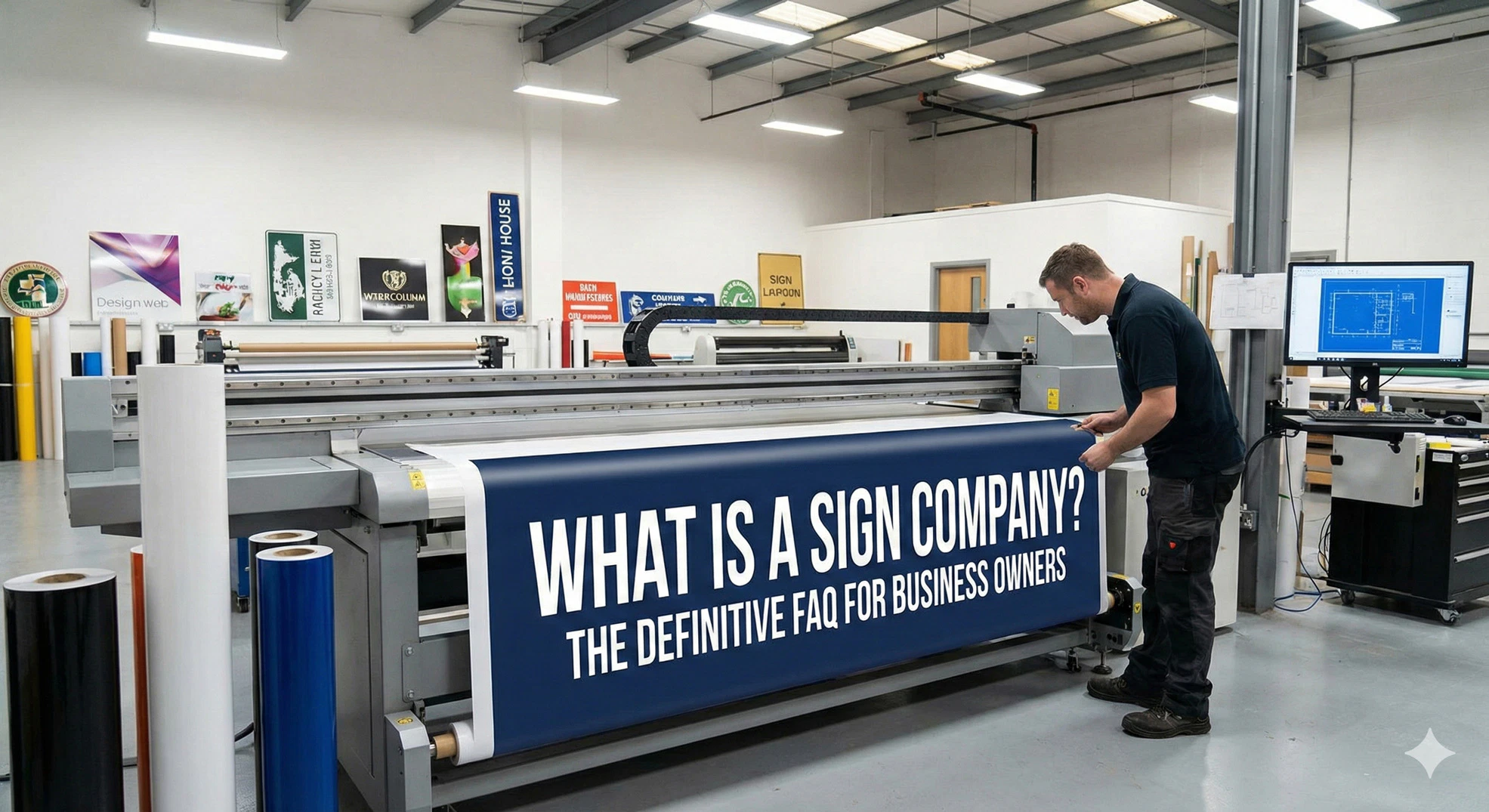
What Is a Sign Company? The Definitive FAQ for Business Owners
Most people think a sign company is where you buy a “sticker” or a “board.” In real business environments, a professional sign company is closer to a visual communications partner. Your sign has to work at the intersection of brand credibility (does it look legitimate?), site reality (what surface is it mounting to?), and rules (what your property manager and local jurisdiction will allow).
This guide breaks down what sign companies actually do, what a “signage company” means, how sign shops differ, and how to think about online portals like Signs.com without turning your project into a re-order or an installation headache.
Core Definitions (So We’re Using the Same Language)
Sign company
A business that plans, designs, produces, installs, and services signage for commercial spaces. Some handle only certain parts (like production), while full-service teams manage the whole lifecycle.
Signage company
Often the same as a sign company, but the term usually implies a system of signs across an environment (exterior identification + interior wayfinding + compliance signage), not just one sign.
Sign shop
A production-focused shop where signs are physically made. A sign shop might be print-first, fabrication-first, or full-service. The difference is scope, not the label.
FAQ: What Is a Sign Company?
1) What does a sign company do?
A sign company helps a business communicate in the physical world. That includes identification signage (your name/logo), directional signage (parking, entrances, deliveries), safety and compliance signage, and promotional signage (events, openings, campaigns). On the production side, a sign company may print graphics, cut and fabricate dimensional letters, apply finishes, and prepare hardware. On the project side, a strong sign company manages the steps that prevent expensive mistakes: confirming measurements, selecting materials that match the environment, deciding how the sign will mount to the surface, and setting proof approval steps so the finished sign matches what you approved.
When installation is part of the job, service matters too—repairs, updates, removals, and rebrands—because signage is a business asset, not a one-time file upload.
2) What is the meaning of a signage company?
A signage company designs, manufactures, and installs visual graphics and physical sign structures intended to communicate information to a specific audience. The word “sign” often refers to a single unit (like a storefront logo). “Signage” usually refers to the collective system of visual markers within an environment.
That difference matters in commercial spaces because people don’t experience one sign at a time—they experience a chain: finding the property, choosing the right entrance, locating the right suite, and navigating interior rooms. A signage company manages that ecosystem: exterior identification, interior wayfinding, directories, suite/room markers, and compliance signage where required.
3) What does a sign shop do?
A sign shop is where the physical craft happens. Some sign shops focus on fast-turn printed products (banners, decals, basic panels). Others handle fabrication work like dimensional lettering, routed PVC, acrylic signage, metal components, and assembly for illuminated signage.
The smart way to evaluate a sign shop is to match its scope to your risk level. If your project is installed on a building, needs approvals, involves electrical, or must last for years in harsh sun and rain, choose a provider that is comfortable planning mounting methods and long-term durability—not only printing.
4) What’s the difference between printing and signage?
Printing is a method; signage is the outcome. Signage includes message + material + finish + placement + mounting + lifespan. A banner becomes a signage decision once it has to survive sun, wind, and mounting tension. A printed panel becomes a signage decision once it has to mount to stucco, glass, metal panels, or masonry and still look clean months later.
This is why professional sign companies talk about substrates and finishes as much as artwork. A sign can fail early if the wrong substrate is used, if edges aren’t protected, or if the mounting method traps water behind the panel.
5) What does a full-service sign company lifecycle look like?
Full-service sign companies tend to follow a predictable lifecycle because that’s how you avoid rework:
- Consultation + site check: measurements, surfaces, sightlines, access, and (if relevant) electrical proximity.
- Approvals planning: landlord standards, property rules, and municipal permit requirements where applicable.
- Design + specification: artwork plus written specs for substrate, thickness, finish, mounting method, and placement.
- Fabrication + finishing: printing, cutting/routing, painting, laminating, assembly.
- Installation + service: safe mounting, clean final presentation, and a plan for updates or repairs.
If a vendor can’t clearly explain their steps, the project is more likely to drift into “we’ll figure it out later,” which is where most sign problems begin.
6) Do sign companies handle permits and compliance?
Many business-focused sign companies support permitting and compliance steps, especially for exterior and illuminated signage. How much they handle depends on the market and the provider. The important reality is that approvals often drive timelines more than production does.
If your sign is building-mounted, illuminated, or large, treat approvals as part of the project plan from day one. It reduces delays and prevents building something that can’t be approved.
7) Why do materials and finishes matter so much?
Because the environment is unforgiving. UV exposure can fade inks, heat can warp thin panels, moisture can creep into unsealed edges, cleaning chemicals can haze plastics, and coastal conditions can accelerate corrosion. Two signs with the same artwork can age completely differently depending on substrate and finish.
In plain terms: the sign you see is a combination of substrate (what it’s made of), finish (how it’s protected and colored), and mounting (how it’s attached). Get one wrong and it shows fast.
8) What are common reasons signs fail early?
Early failures are usually predictable: wrong material for the environment, wrong finish for UV exposure, wrong adhesive for the surface, poor surface prep, edges left unprotected, or a mounting method that traps water behind a panel. Another failure is readability: fonts too thin, low contrast, or letter height too small for the viewing distance—especially at street speed.
A professional sign company reduces these failures by writing down specs before production starts: substrate, thickness, finish type, mounting method, and intended viewing distance.
9) Are ADA signs part of what a sign company does?
Yes. Many sign companies produce ADA-compliant interior signage for commercial spaces: room identification, restrooms, exits, stairwell floors, and other permanent areas. ADA signage can involve tactile elements, braille, placement rules, contrast, and legibility standards.
If your space is commercial and tied to inspections or tenant improvements, ADA signage is usually not the place to guess. If you want a deeper explainer, see ADA compliance in signage design.
10) Is Signs.com a legit website?
Signs.com is a high-volume online sign ordering platform, and it’s commonly used for standard printed products like banners, yard signs, decals, posters, and basic panels. Where projects get tricky is the gap between an online vendor and a signage partner.
Online portals typically cannot perform site surveys, coordinate local approvals, or provide professional installation as part of a controlled scope. For more complex signage—building-mounted signs, illuminated letters, or ADA packages tied to inspections—ordering online can lead to “fitment failure”: the sign arrives, but it doesn’t fit the space, can’t be mounted cleanly, or doesn’t meet a requirement.
Online ordering can be a smart choice for low-risk, standardized prints. For installed, long-life, compliance-sensitive signage, a full-service sign company reduces risk by verifying site conditions and planning installation before production.
11) Professional sign company vs online portal: what’s the practical difference?
The difference is responsibility. Online portals are best when you already know size and install method, and the consequences of being slightly wrong are small. A professional sign company is best when the job is installed, regulated, long-term, or brand-critical.
| Feature | Professional Sign Company | Online Portal |
|---|---|---|
| Site measurement | Verified or guided | Customer-provided |
| Material + finish selection | Matched to environment | Preset choices |
| Permits / property rules | Often supported | Typically not included |
| Installation | Planned and executed | DIY / third-party |
| Accountability | One partner owns outcome | Split across vendors |
12) How much does a professional sign cost?
Costs vary widely based on sign type, size, materials, finishing, access, installation, and approvals. A simple print product is priced like print. A fabricated and installed exterior sign is priced like an installed asset because it includes hardware, labor, access planning, and long-term durability considerations.
If you want a fast budget range, define the sign type, approximate size, and whether installation/approvals are involved. If you want a structured way to share that, use: https://www.titansofprint.com/quotes.
13) Do I need a permit for my business sign?
Often for exterior signs, permits or property approvals are common, but it depends on your jurisdiction and property rules. Even when a municipal permit isn’t required for a specific sign type, landlords and commercial centers frequently have design criteria that function like an approval process. The best practice is to confirm early, because approvals affect size, lighting options, placement, construction, and timeline.
14) What should I ask a sign company before hiring them?
Ask questions that reveal process and accountability: Do you verify measurements or rely on mine? What material and finish do you recommend for this location, and why? How will it mount to the surface? What approvals should happen before production? What does proof approval include? What warranty applies to both the sign and the installation? Who services the sign later if something fails?
Those answers tell you whether the vendor is selling a product or managing an outcome.
15) In plain English: what is a sign company?
A sign company is the team that makes your business visible, credible, and navigable in the real world. Sometimes that’s as simple as producing a banner. In many business environments, it’s an installed system that must fit the building, survive the environment, and sometimes meet approvals. A strong sign company makes the outcome predictable by planning measurements, specs, and mounting methods before production—so you don’t pay twice.
About Titans of Print (Experience + Standards)
Titans of Print is a Miami-based sign and printing team focused on business clients—commercial signage, large-format graphics, and projects that require real-world planning (surfaces, finishes, mounting methods, and installation). The approach is straightforward: measure when measurement matters, write specs before production, and treat signage like a long-term business asset.
If you want a simple way to share photos, approximate sizes, and your goals for a neutral scope check, you can use: https://www.titansofprint.com/quotes.
One Credible Reference
For official ADA signage guidance, the U.S. Access Board provides a clear resource: https://www.access-board.gov/files/ada/guides/signs-ADA.pdf